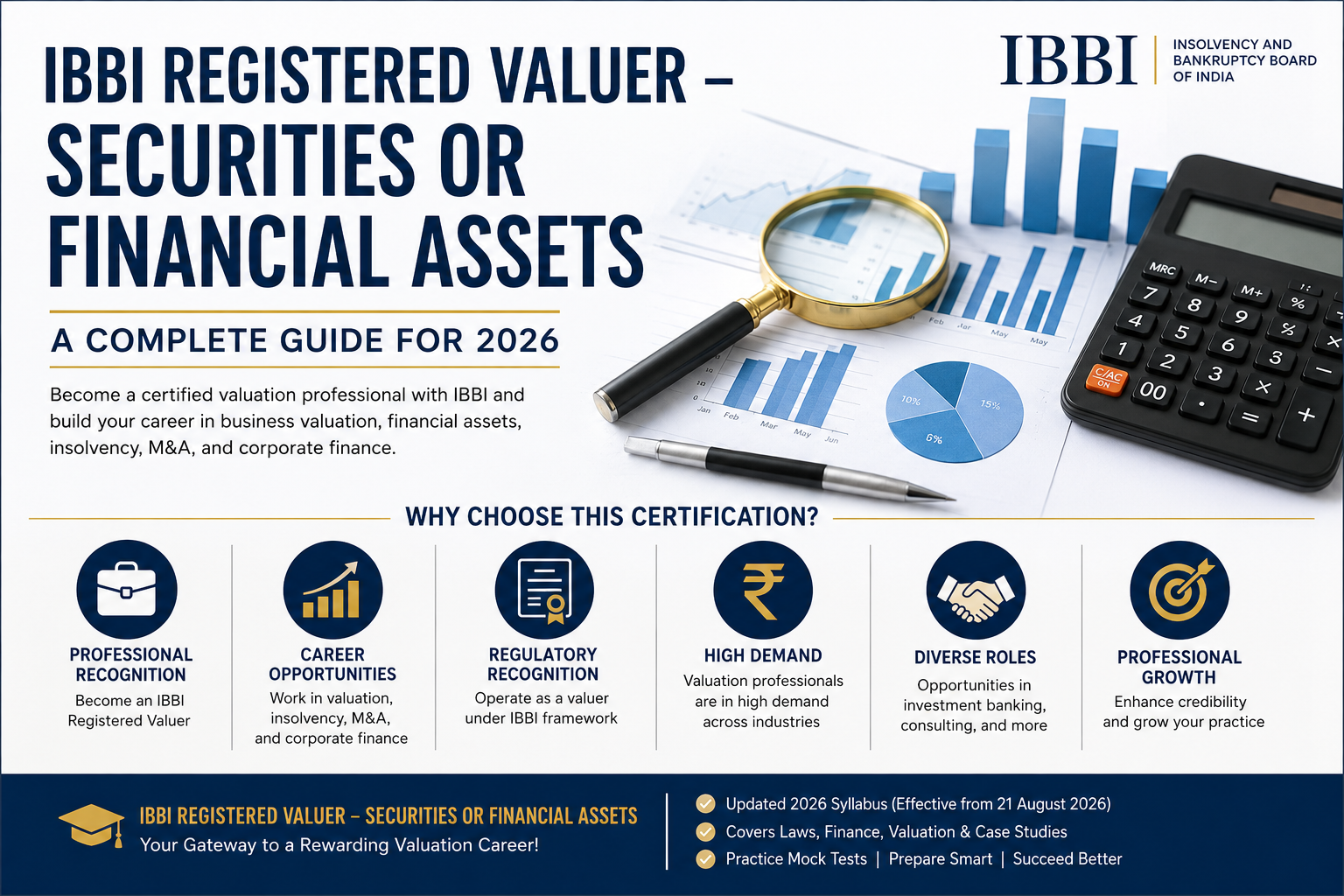
If you are a finance professional looking to build a career in business valuation, financial asset valuation, insolvency, mergers and acquisitions, or corporate finance, becoming an IBBI Registered Valuer – Securities or Financial Assets can be an important professional qualification.
The Insolvency and Bankruptcy Board of India (IBBI) conducts valuation examinations for different asset classes under the Companies (Registered Valuers and Valuation) Rules, 2017. Securities or Financial Assets is one of the recognized asset classes for which candidates can qualify as Registered Valuers, subject to meeting the applicable requirements.
IBBI has announced the Phase 6 Valuation Examination syllabus for Securities or Financial Assets, effective from 21 August 2026. The updated syllabus covers economics, finance, financial statement analysis, valuation methodologies, securities, fixed-income instruments, intangible assets, business valuation, laws, accounting standards, case studies and more.
This guide explains the IBBI Registered Valuer – Securities or Financial Assets qualification, examination pattern, syllabus, important topics and preparation strategy.
What is an IBBI Registered Valuer?
An IBBI Registered Valuer (RV) is a professional registered under the regulatory framework governing registered valuers in India and authorized to undertake valuation assignments within the relevant asset class, subject to applicable laws, regulations and professional requirements.
Valuation plays an important role in areas such as:
- Insolvency and bankruptcy
- Mergers and acquisitions
- Corporate restructuring
- Financial reporting
- Fundraising
- Securities valuation
- Business valuation
- Tax and regulatory purposes
- Fair value measurement
- Corporate transactions
For professionals interested specifically in financial assets and business valuation, the Securities or Financial Assets asset class is particularly relevant.
What is Securities or Financial Assets Valuation?
The Securities or Financial Assets asset class focuses on valuation of financial instruments, businesses and related financial assets.
The scope of the examination includes topics such as:
- Equity and business valuation
- Fixed-income securities
- Financial instruments
- Derivatives
- Intangible assets
- Financial guarantees
- Valuation of investment entities
- Distressed asset valuation
- Start-up valuation
- SME valuation
- Business combinations
The 2026 IBBI syllabus also includes valuation approaches such as the cost approach, market approach and income approach.
IBBI Registered Valuer – Securities or Financial Assets: 2026 Examination
IBBI's Phase 6 valuation examination for the Securities or Financial Assets asset class is scheduled to commence from 21 August 2026. The syllabus published by IBBI states that laws, rules and regulations referred to in the syllabus are to be taken as notified as on 30 June 2026.
Examination Overview*
| Particular | Details |
|---|---|
| Asset Class | Securities or Financial Assets |
| Authority | IBBI |
| Examination Mode | Online, computer-based, proctored |
| Duration | 2 hours |
| Maximum Marks | 100 |
| Passing Marks | 60% |
| Negative Marking | 25% of marks assigned to the question |
| Frequency | Every working day |
| Current Examination Fee | ₹5,900 including GST |
| Calculator | Non-memory-based calculator permitted |
| Effective Syllabus | 21 August 2026 |
These details are based on IBBI's May 20, 2026 announcement for Phase 6 examinations.
Important: Examination fees, procedures and other administrative details can change. Candidates should always verify the latest information on the official IBBI examination page before registering.
IBBI Valuation Examination Syllabus – Securities or Financial Assets
The updated syllabus is broad and combines finance, accounting, economics, law and valuation.
The major areas are as follows.
1. Macroeconomics – 3%
The examination covers fundamental macroeconomic concepts including:
- National income accounting
- GDP and NDP
- Consumption and investment
- Fiscal policy
- Monetary policy
- Government deficits
- Money multiplier
- Business cycles
- Yield curves
- Understanding economic conditions is important because changes in interest rates, inflation, liquidity and economic growth can influence business and financial asset values.
2. Finance and Financial Statement Analysis – 6%
This section covers fundamental finance and financial analysis concepts.
Important topics include:
- Time value of money
- Investment decisions
- Financing decisions
- Dividend decisions
- Net Present Value (NPV)
- Internal Rate of Return (IRR)
- Payback period
- Balance sheet analysis
- Profit and loss analysis
- Ratio analysis
- Cash flow analysis
- Capital structure analysis
- Credit analysis
Candidates preparing for the examination should be comfortable interpreting financial statements rather than merely memorizing formulas.
3. Professional and Business Ethics – 3%
Professional ethics is an important component of the Registered Valuer framework.
The syllabus includes:
- Professional competence
- Due care
- Independence
- Conflict of interest
- Disclosure of interest
- Confidentiality
- Information management
- Gifts and hospitality
- Integrity and fairness
- Engagement letters
- Management representations
- Use of experts
- Quality review
- Responsibilities of valuers
The syllabus also includes the Digital Personal Data Protection Act, 2023 and rules made thereunder.
4. General Laws – 18%
This is one of the most important areas of the examination.
The syllabus covers:
Companies Act, 2013
Candidates should study relevant provisions concerning:
- Share capital
- Debentures
- Compromises and arrangements
- Amalgamations
- Registered Valuers
- Winding up
Other Important Laws
The syllabus also covers:
- Transfer of Property Act, 1882
- Indian Stamps Act, 1899
- Income-tax Act, 2025
- Insolvency and Bankruptcy Code, 2016
- SARFAESI Act, 2002
SEBI Regulations
Important SEBI regulations listed in the syllabus include regulations relating to:
- Takeovers
- Insider trading
- Issue of capital and disclosure requirements
- Delisting
- Share-based employee benefits
RBI and FEMA
The syllabus also includes selected RBI regulations and FEMA-related provisions concerning securities, foreign investment and banking investment portfolios.
Because this section carries 18%, candidates should allocate significant preparation time to it.
5. Financial Reporting under Ind AS – 3%
The examination includes important concepts relating to financial reporting and fair value.
Topics include:
- Fair value
- Fair value adjustments
- Highest and best use
- Fair value techniques
- Financial statement disclosures
- Ind AS 36 – Impairment of Assets
- Ind AS 109 – Financial Instruments
- Ind AS 103 – Business Combinations
- Ind AS 113 – Fair Value Measurement
6. Overview of Valuation – 4%
This section establishes the foundation for understanding valuation.
Candidates should understand:
Price vs Value
Price represents the amount agreed in a transaction, while value is an analytical estimate based on a defined purpose, premise and methodology.
Types of Value
The syllabus includes:
- Fair market value
- Fair value
- Intrinsic value
- Investment value
- Synergistic value
- Market value
- Special value
Premise of Valuation
Two important premises are:
- Going concern
- Liquidation
The syllabus also covers the valuation process, valuation reports and documentation requirements.
7. Valuation Approaches – 3%
A strong understanding of valuation approaches is essential.
Cost Approach
Topics include:
- Net Asset Value
- Book Value
- Adjusted value
- Sum-of-the-parts
- Replacement cost
Market Approach
Topics include:
- Quoted market price
- Recent investment price
- Recent transaction price
- Relative valuation
- Valuation multiples
- Comparable companies
- Adjustments to multiples
Income Approach
This includes:
- Discounted Cash Flow (DCF)
- Terminal value
- Present value
- Adjusted Present Value
- IRR
- Earnings capitalization
- Perpetual growth
- Cost of capital
- Capitalization rate
8. Valuation Application
This is one of the most practical sections of the examination.
The syllabus covers Equity and Business Valuation, including:
- Business environment analysis
- Business model analysis
- Industry analysis
- Regulatory framework
- Porter's Five Forces
- SWOT analysis
- PEST analysis
- GE/McKinsey Matrix
- ADL Matrix
- Core competencies
It also covers:
- Business combinations
- Mergers
- Amalgamations
- Demergers
- Restructuring
- Due diligence
- Business risk assessment
- Historical financial analysis
- Forecasting
- Cash flow analysis
- CAPM
- Modified CAPM
- WACC
- Arbitrage Pricing Theory
- Risk adjustments
- Discounts and premiums
The IBBI syllabus also includes IBBI valuation guidelines and the latest International Valuation Standards referenced in the syllabus.
Fixed Income Securities
Fixed-income valuation is another important component.
Candidates should understand:
- Government securities
- State and local government bonds
- Corporate bonds
- Money market instruments
- Commercial Paper
- Certificates of Deposit
- Treasury Bills
- Asset-backed securities
- Preferred stock
- Important bond concepts include:
- Coupon rate
- Par value
- Clean price
- Dirty price
- Yield to maturity
- Yield to call
- Yield to put
- Spot rate
- Forward rate
The syllabus also covers Macaulay Duration, Modified Duration, Effective Duration and Key Duration.
Derivatives and Option Valuation
The Securities or Financial Assets syllabus also covers derivatives.
Candidates should be familiar with:
- Derivative products
- Swaps
- Swap rates
- Valuation of swaps
- Option valuation
- Black-Scholes model
- Black-Scholes-Merton model
- Binomial tree method
- Monte Carlo simulation
These topics make the examination particularly relevant for candidates with backgrounds in investment banking, equity research, portfolio management and financial markets.
Intangible Asset Valuation
Modern businesses often derive significant value from intangible assets.
The syllabus covers:
- Nature and classification of intangible assets
- Useful life
- Acquired vs internally generated assets
- Assets generating independent cash flows
- Intangible assets under development
- Research assets
Valuation methods include:
- Excess Earnings Method
- Relief-from-Royalty Method
- Premium Profit Method
- Greenfield Method
- Distributor Method
The syllabus also considers intangible asset valuation for financial reporting, taxation, transactions, collateral lending, licensing and insolvency/bankruptcy.
Situation-Specific Valuation
Candidates should also understand how valuation changes depending on the circumstances.
The syllabus specifically mentions:
- Distressed asset valuation
- Start-up valuation
- Small and medium enterprise valuation
- Cyclical company valuation
- Investment entity valuation
- Insurance-related valuation
Judicial Pronouncements and Case Studies
The examination is not limited to theoretical concepts.
The syllabus includes important judicial pronouncements relating to valuation, including cases involving corporate transactions and valuation disputes.
More importantly, case studies account for 26% of the examination.
The case-study section consists of three case studies:
- One case study with six 2-mark questions – 12 marks
- One case study with four 2-mark questions – 8 marks
- One case study with three 2-mark questions – 6 marks
That means candidates should practice applying valuation concepts to real-world scenarios rather than relying only on memorization.
How to Prepare for the IBBI Registered Valuer Exam
A good preparation strategy should combine conceptual study, numerical practice, legal provisions and case studies.
Step 1: Understand the Syllabus
Start by downloading the latest syllabus from IBBI and divide it into manageable sections.
Prioritize high-weightage areas such as:
- General Laws
- Finance
- Valuation Application
- Fixed Income Securities
- Case Studies
Step 2: Build Your Finance Fundamentals
Before starting advanced valuation, make sure you understand:
- Time value of money
- NPV
- IRR
- Cash flows
- Financial statements
- Ratios
- Cost of capital
- CAPM
- WACC
These concepts appear throughout the valuation syllabus.
Step 3: Practice Valuation Problems
Do not study valuation only theoretically.
Practice problems involving:
- DCF
- Multiples
- Bond valuation
- Duration
- Option pricing
- Business valuation
- Discount rates
- Terminal value
- Intangible asset valuation
Step 4: Study the Laws Carefully
The law section can be challenging because questions may test specific provisions and their application.
Create concise revision notes for:
- Companies Act
- Companies (Registered Valuers and Valuation) Rules
- IBC
- SARFAESI
- SEBI regulations
- FEMA
- Income-tax provisions
- Ind AS
Always use the latest applicable legal and regulatory material.
Practice IBBI Valuation Mock Tests
Reading the syllabus is only the beginning.
Because the examination is computer-based and includes objective questions as well as case-study-based questions, candidates should practice answering questions under time pressure.
A good IBBI Registered Valuer mock test can help you:
- Test your understanding
- Identify weak areas
- Improve calculation speed
- Practice valuation concepts
- Become familiar with MCQ-style questions
- Improve time management
- Build confidence before the examination
For candidates preparing through PassNISM, practice questions can be used as a supplementary preparation tool alongside the official IBBI syllabus and applicable study material.
[Practice IBBI Registered Valuer – Securities or Financial Assets Questions →]
IBBI Registered Valuer vs NISM Certification
It is important not to confuse the IBBI Registered Valuer examination with a regular NISM certification examination.
NISM conducts several certification examinations for professionals in securities and financial markets. For example, NISM currently lists certifications such as NISM Series XV: Research Analyst, Investment Adviser, Equity Derivatives and Portfolio Managers.
The IBBI Valuation Examination for Securities or Financial Assets, however, is part of the Registered Valuer framework administered by IBBI.
The two can cover overlapping areas such as securities markets, valuation and financial analysis, but they serve different regulatory and professional purposes.
Who Should Consider the Securities or Financial Assets Asset Class?
This asset class may be particularly relevant to professionals interested in:
- Business valuation
- Equity valuation
- Financial asset valuation
- Investment banking
- Corporate finance
- Mergers and acquisitions
- Insolvency and restructuring
- Financial reporting
- Valuation advisory
- Investment analysis
Candidates should separately verify the applicable eligibility, educational qualification, experience and registration requirements before beginning the registration process.
Passing the valuation examination by itself should not be interpreted as automatic registration as a Registered Valuer.
How Difficult is the IBBI Valuation Examination?
The examination can be challenging because it combines several disciplines.
You may need to move from:
Macroeconomics → Financial Statements → Companies Act → Valuation → Fixed Income → Derivatives → Intangibles → Case Studies
within the same examination.
The combination of negative marking and a 60% passing requirement makes accuracy particularly important. IBBI currently specifies a 25% negative mark for an incorrect answer.
A candidate should therefore focus on understanding concepts rather than attempting questions randomly.
Frequently Asked Questions
What is IBBI Registered Valuer – Securities or Financial Assets?
It is an asset class under the Registered Valuer framework covering valuation of securities, businesses and various financial assets and related instruments.
What is the passing score for the IBBI Valuation Examination?
The current IBBI examination specification requires candidates to secure 60% marks to pass.
Is there negative marking?
Yes. A wrong answer attracts a negative mark equal to 25% of the marks assigned to that question.
What is the duration of the examination?
The examination duration is currently 2 hours.
Is the examination conducted online?
Yes. IBBI states that the examination is conducted online in a computer-based, proctored environment.
Can I use a calculator?
A non-memory-based calculator is permitted. Scientific calculators, whether memory-based or otherwise, are not permitted according to the current examination instructions.
Does IBBI provide a workbook for this examination?
The current examination notification states that no workbook or study material is allowed or provided as part of the examination. Candidates should therefore prepare using the applicable syllabus, regulations, standards and other relevant resources.
How much of the examination is case-study based?
The case-study section carries 26 marks out of 100, making application-based preparation extremely important.
Final Thoughts
Becoming an IBBI Registered Valuer – Securities or Financial Assets requires more than knowledge of stock markets.
The 2026 syllabus covers a broad combination of economics, finance, accounting, corporate law, securities regulations, valuation methodologies, fixed-income instruments, derivatives, intangible assets and practical case studies.
The best preparation strategy is therefore to:
- Understand the official syllabus.
- Build strong finance fundamentals.
- Study the relevant laws and regulations.
- Learn the major valuation methodologies.
- Practice numerical problems.
- Solve case-study questions.
- Take regular mock tests.
- Review every mistake.
- Revisit weak topics before the examination.
With systematic preparation and regular practice, candidates can approach the IBBI Valuation Examination with much greater confidence.
Start your preparation with the latest syllabus, practice questions and mock tests, and make every practice attempt count.
Important Note
This article is intended for educational and exam-preparation purposes. Regulatory requirements, syllabus, fees, examination procedures and applicable laws can change. Candidates should verify the latest information directly from IBBI before applying or appearing for the examination.
Official Reference
The current Phase 6 syllabus for Securities or Financial Assets, effective from 21 August 2026, is published by IBBI.