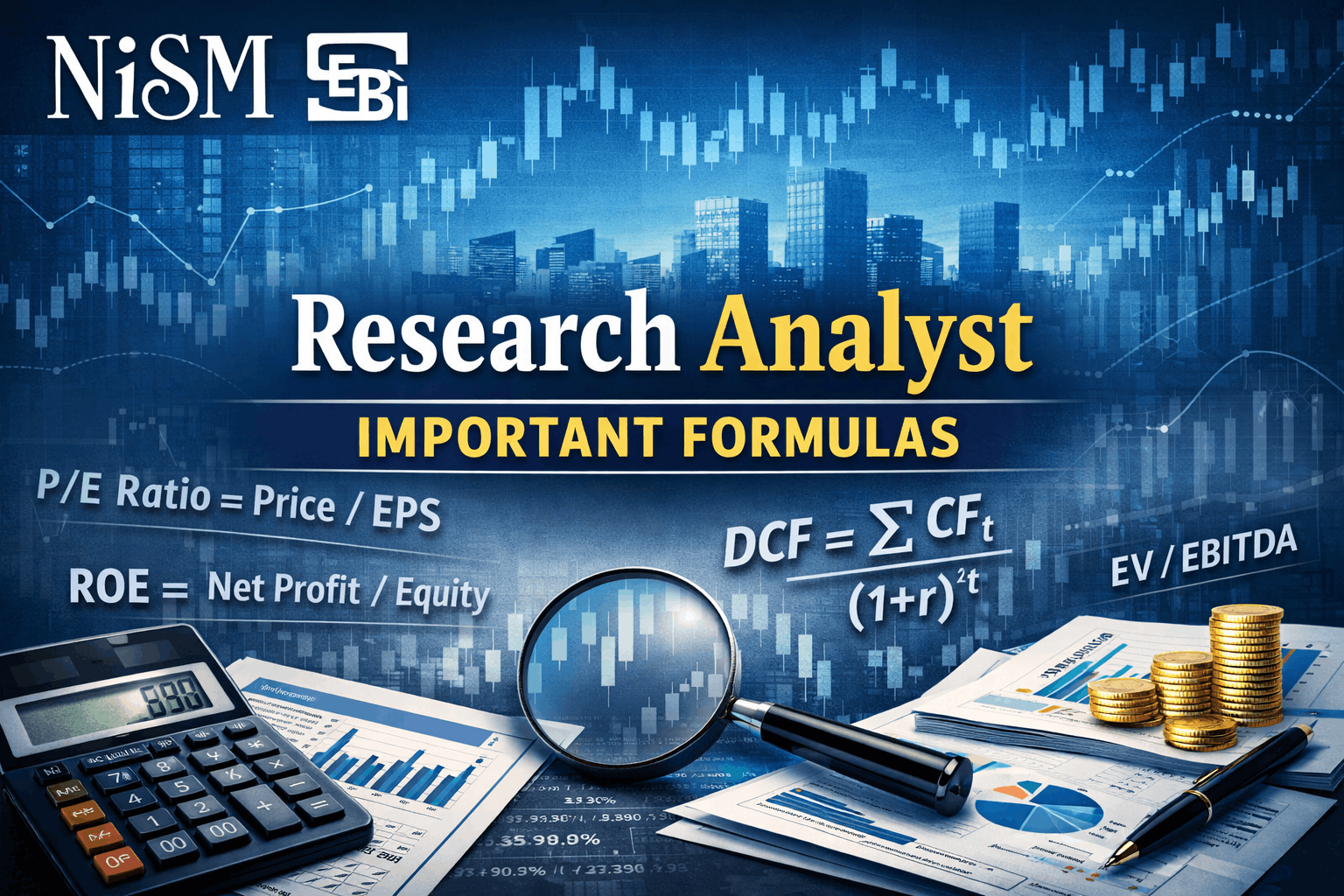
NISM Research Analyst Exam 2026: Important Formula Guide:
50 important formulas explained simply, plus a beginner-friendly roadmap to passing the 2026 exam.
By the PassNISM Editorial Team, reviewed against the official NISM Series XV syllabus · Last updated: July 13, 2026
The NISM Research Analyst exam, an important 2026 certification regulated by SEBI (Securities and Exchange Board of India) and administered by NISM (National Institute of Securities Markets), tests whether you can read a balance sheet, value a stock, and judge risk like a professional analyst. This simple guide walks beginners through what the exam covers, why it matters, who should take it, and how to prepare — followed by the 50 important formulas you actually need to memorize. For extra practice, try a free NISM Research Analyst mock test, work through chapter-wise sample questions, download condensed study notes, or review the exam-day checklist before your 2026 attempt.
What Is the NISM Research Analyst Exam?
The NISM Research Analyst Certification Examination (NISM Series XV) is a SEBI-mandated certification for individuals who research, analyze, or recommend securities in India, required under Regulation 7(2) of the SEBI (Research Analysts) Regulations, 2014. It covers financial statement analysis, valuation, and regulatory conduct — including rules around research on AIFs (Alternative Investment Funds, i.e. pooled investment vehicles like PE/hedge funds) and mutual fund NAV (Net Asset Value, the per-unit worth of a fund's holdings) — and is a prerequisite for registering as a Research Analyst with SEBI. In short: it's the exam that proves you can turn raw financial data into a defensible investment view.
Why Does the NISM Research Analyst Exam Matter?
Passing this exam isn't just a formality — it's a legal requirement for anyone in India who wants to publish research reports, give buy/sell recommendations, or work as a registered Research Analyst. Beyond compliance, it matters because:
- SEBI registration is legally required to operate as a Research Analyst in India.
- Employers (brokerages, AMCs, research firms) treat the certificate as a baseline hiring filter.
- The formulas tested are the same ones used daily in equity research, credit analysis, and portfolio management.
Who Should Take the NISM Research Analyst Exam?
This certification is relevant for a specific set of roles, not everyone in finance. You should consider it if you are:
- An aspiring or practicing equity/credit research analyst
- A portfolio manager or investment advisor who publishes research
- A finance student targeting roles in equity research, investment banking, or asset management
- A working professional in a brokerage who issues stock recommendations or price targets
When Should You Start Preparing?
A realistic beginner's timeline for the NISM Research Analyst exam:
| Weeks Before Exam | Focus |
|---|---|
| Week 1–2 | Read the NISM workbook once; skim all chapters for structure |
| Week 3–5 | Deep-dive financial statement analysis, valuation, and formulas (this guide) |
| Week 6 | Attempt sample questions and a full-length mock test |
| Week 7 | Revise weak areas, redo formula sheet, take 2–3 more mock tests |
| Week 8 | Light revision only; avoid new topics |
How Can You Pass the NISM Research Analyst Exam?
- Get the official workbook — start with SEBI/NISM's prescribed study material.
- Build a formula sheet — use the 50 formulas below as your master list.
- Practice with a mock test weekly to track your accuracy under time pressure.
- Drill sample questions chapter by chapter to close specific gaps.
- Review regulatory/ethics sections — these are easy marks often ignored by beginners.
- Simulate exam conditions in your final week: timed, no notes, full-length paper.
Exam pattern to plan around: 100 marks, 2 hours, and negative marking (a penalty deducted for each wrong answer — here, 25% of that question's marks) on every incorrect response. The passing score is 60%. Because guessing carries a real cost, only answer when you're reasonably confident, and mark uncertain questions for review instead of guessing blindly.
NISM Research Analyst vs NCFM: How Do They Compare?
| Feature | NISM Research Analyst (Series XV) | NCFM |
|---|---|---|
| Regulator | SEBI-mandated | NSE-administered |
| Purpose | Legal requirement to register as a Research Analyst | Skill/knowledge certification, not a legal registration requirement |
| Core Focus | Valuation, financial statement analysis, ethics | Varies by module (technical analysis, derivatives, etc.) |
| Validity | 3 years, renewable via CPE | Varies by module |
What Are the 50 Must-Know Formulas?
These are grouped by category, exactly as they appear in a typical NISM Research Analyst formula sheet. Use them alongside sample MCQ practice to test recall.
Financial Statement & Profitability Formulas:
(Current Revenue − Previous Revenue) ÷ Previous Revenue × 100
Revenue − Cost of Goods Sold
Gross Profit ÷ Revenue × 100
Gross Profit − Operating Expenses
EBIT ÷ Revenue × 100
Revenue − All Expenses − Tax
Net Profit ÷ Revenue × 100
Net Profit + Interest + Tax + Depreciation + Amortization
EBITDA ÷ Revenue × 100
Net Profit ÷ Total Shares Outstanding
Valuation Formulas (Core of Equity Research):
Market Price per Share ÷ EPS
(Forward P/E uses expected future earnings)
P/E ÷ Earnings Growth Rate
Market Price ÷ Book Value per Share
(Total Assets − Liabilities) ÷ Shares
Market Cap + Debt − Cash
(EV/EBITDA is widely used in M&A)
Share Price × Total Shares
Dividend per Share ÷ Market Price × 100
Dividend ÷ Net Profit × 100
Liquidity & Solvency Ratios:
Current Assets ÷ Current Liabilities
(Current Assets − Inventory) ÷ Current Liabilities
Total Debt ÷ Shareholders' Equity
EBIT ÷ Interest Expense
Total Debt ÷ Total Assets
Return Ratios (Highly Tested):
Net Profit ÷ Shareholders' Equity × 100
Net Profit ÷ Total Assets × 100
EBIT ÷ Capital Employed × 100
Revenue ÷ Total Assets
Cash Flow & Efficiency Metrics:
Operating Cash Flow − Capital Expenditure
COGS ÷ Average Inventory
Revenue ÷ Average Receivables
Inventory Days + Receivable Days − Payable Days
Growth, Risk & Market Metrics:
(Ending Value ÷ Beginning Value)^(1/n) − 1
(Return − Risk-Free Rate) ÷ Standard Deviation
(Beta, Alpha, and Standard Deviation are the related risk/volatility measures tested alongside this.)
Valuation Models Every Research Analyst Must Know:
Σ Cash Flow ÷ (1 + Discount Rate)^t
FCF × (1 + g) ÷ (r − g)
g = Growth rate, r = Discount rate (usually WACC)
WACC = (E / V × Re) + (D / V × Rd × (1 − T))
Re = Rf + β(Rm − Rf)
(Intrinsic Value − Market Price) ÷ Intrinsic Value
What Do Sample Exam Questions Look Like?
The NISM Research Analyst paper has 80 standalone MCQs (1 mark each) plus 5 case studies (4 questions each, 20 marks total) — 100 marks in all, in 2 hours. Typical question patterns include:
- Direct calculation: "A company has Net Profit ₹50 lakh and Shareholders' Equity ₹250 lakh. What is its ROE?" (Answer: 20%)
- Definition-based: "Which ratio excludes inventory from current assets?" (Answer: Quick Ratio)
- Applied scenario: "A stock trades at ₹400 with EPS ₹20 and expected earnings growth of 10%. What is its PEG ratio?" (Answer: 2.0)
Mini Case Scenario
Case: An analyst is reviewing a company with Revenue ₹800 crore, Net Profit ₹96 crore, and Shareholders' Equity ₹480 crore.
Q1: What is the Net Profit Margin? → 96 ÷ 800 × 100 = 12%
Q2: What is the ROE? → 96 ÷ 480 × 100 = 20%
Q3: If the stock trades at a P/E of 18 with EPS ₹15, what is the market price? → 18 × 15 = ₹270
Score Benchmarks
- Passing score: 60 out of 100 marks (60%).
- Negative marking: 25% of a question's marks deducted for each wrong answer — so a wrong 1-mark MCQ costs 0.25 marks.
- Mock-test target: aim for a consistent 70%+ on timed, full-length mocks in your final week; exam-day pressure typically shaves off a few marks, so a comfortable buffer above 60% matters.
Most beginners scoring below the 60% passing benchmark on their first mock test are missing valuation-model questions (DCF, WACC, CAPM) — prioritize these in revision, then retest with a full mock test.
Which Exam Should You Choose? A Quick Decision Guide
- If you plan to publish stock research or set price targets → the NISM Research Analyst exam is mandatory for you.
- If you are a dealer or broker executing trades only → you likely need a different NISM series (e.g., Series VIII) rather than Research Analyst.
- If you are a student exploring finance broadly → NCFM modules can be a lighter starting point before attempting NISM Research Analyst.
- If you already work in equity research → go straight for NISM Research Analyst since it's likely a registration requirement for your role.
Frequently Asked Questions:
Q1. Is the NISM Research Analyst exam hard for beginners?
Ans: It's manageable with structured prep. Most difficulty comes from valuation formulas (DCF, WACC, CAPM) — practicing these with a formula sheet and mock tests resolves most of the gap.
Q2. How many formulas are asked in the NISM Research Analyst exam?
Ans: There's no fixed count, but the 50 formulas in this guide cover the categories the exam consistently draws from: profitability, valuation, liquidity, returns, cash flow, and risk.
Q3. What is the passing score for NISM Research Analyst?
Ans: 60 marks out of 100 (60%), with negative marking of 25% per wrong answer, per the official NISM Series XV exam notification. Always confirm the current figure on nism.ac.in, as cutoffs can be revised.
Q4. What does negative marking mean in this exam?
Ans: Negative marking means marks are deducted for wrong answers — here, 25% of that question's marks per incorrect response. It's why guessing randomly on the NISM Research Analyst paper can cost you more than leaving a question unanswered.
Q5. Is NISM Research Analyst certification valid for life?
Ans: No — like most NISM certifications, it typically has a fixed validity period and needs renewal through a Continuing Professional Education (CPE) program.
Summary: Key Takeaways
- The NISM Research Analyst exam is a SEBI-mandated certification for anyone publishing investment research in India.
- It's aimed at research analysts, investment advisors, and finance professionals — not every finance role needs it.
- Start preparing 6–8 weeks out, moving from workbook reading to formula mastery to mock tests.
- The 50 formulas above span profitability, valuation, liquidity, returns, cash flow, and risk models.
- Valuation models (DCF, WACC, CAPM) are the highest-difficulty, highest-weight area for most beginners.
- Practicing with a mock test and sample questions matters as much as memorizing formulas.
- Choose NISM Research Analyst over NCFM if your role requires SEBI registration, not just skill validation.
Ready to test your recall? Take a full-length NISM Research Analyst mock test, work through more sample questions by chapter, or bookmark these quick-reference study notes for last-minute revision.
Official Sources
- NISM Series XV: Research Analyst Certification Examination — official syllabus, fees, and exam pattern
- SEBI (Securities and Exchange Board of India) — regulator and source of the Research Analyst Regulations, 2014
This guide is independently written and periodically reviewed for accuracy against the sources above. It does not replace the official NISM workbook, which is the authoritative study material for the exam.