NISM Series XIII: Common Derivatives Certification — Complete 2026 Guide
Last updated: September 2026
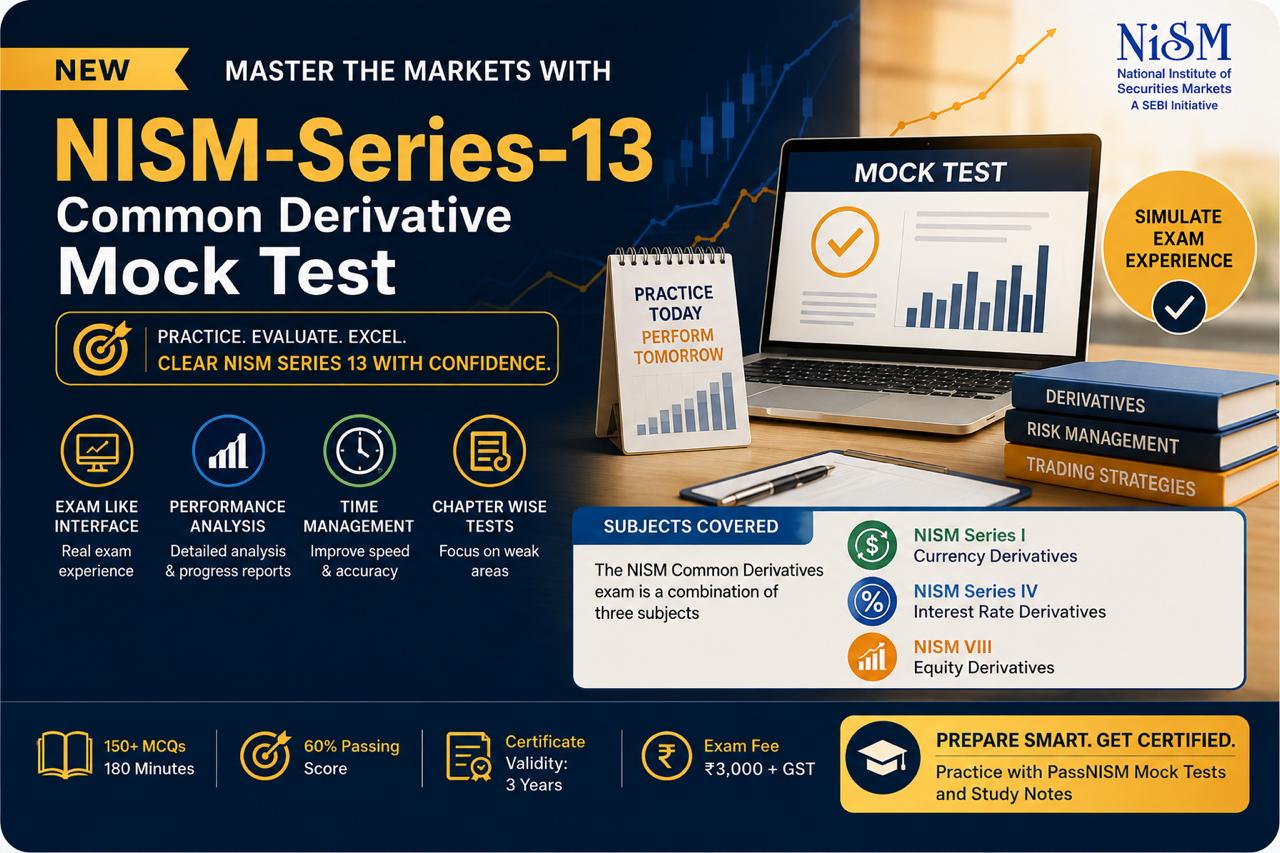
The NISM-Series-XIII: Common Derivatives Certification Examination is one of the broadest certifications offered by the National Institute of Securities Markets (NISM). Instead of testing knowledge of a single derivatives segment, it combines Equity Derivatives, Currency Derivatives, and Interest Rate Derivatives into a single examination.
This guide walks through what the exam covers, who should take it, when to start preparing, why it matters for your career, the full syllabus weightage, and a structured study plan — along with links to practice resources you can use right away.
Disclaimer: This article is an independent study resource and is not published or endorsed by NISM. For official curriculum, updates, and registration, always refer to nism.ac.in and sebi.gov.in.
What Is NISM Series XIII: Common Derivatives?
NISM-Series-XIII: Common Derivatives is an additional certification option that brings together the standards covered by three individual exams:
- NISM-Series-I: Currency Derivatives
- NISM-Series-IV: Interest Rate Derivatives
- NISM-Series-VIII: Equity Derivatives
Rather than specializing in one underlying market, candidates who clear Series XIII are considered to have met the knowledge standards of all three individual certifications. It was introduced as an alternative route for professionals whose roles span multiple derivatives segments, rather than requiring them to sit for three separate exams.
Who Should Take NISM Series XIII?
This certification is best suited for:
- Dealers and traders who deal in more than one derivatives segment (equity, currency, and interest rate) rather than a single market
- Risk and compliance professionals at brokerages, banks, or clearing corporations who need a working knowledge across derivatives categories
- Relationship managers and advisors who need to explain futures, options, and derivatives strategies across multiple asset classes to clients
- Finance and treasury professionals in corporates or banks who hedge using currency and interest rate derivatives alongside equity exposure
- Candidates preparing for SEBI-mandated certifications where a broader derivatives qualification is preferred over three separate exams
If your role only ever touches one segment — say, purely equity derivatives — the individual NISM-Series-VIII exam may be a faster, more targeted route. Series XIII makes the most sense when your work (or career plans) cross multiple derivatives markets.
Which Exam Should You Choose? A Quick Decision Tree
Use this flow to decide between Series XIII and the individual exams:
- If you are a dealer or trader working across equity, currency, and rates desks → choose Series XIII, since it covers all three segments in one certification.
- If you are a dealer working only on an equity derivatives desk → choose Series VIII (Equity Derivatives) for a faster, more targeted route.
- If you handle only forex/currency hedging for a bank or corporate treasury → choose Series I (Currency Derivatives).
- If your role is focused on bond desks, fixed income, or interest-rate hedging → choose Series IV (Interest Rate Derivatives).
- If you already hold one or two of the individual certifications and need the remaining coverage → check whether appearing for the missing individual exam(s) or switching to Series XIII is faster; Series XIII is often more efficient if you're missing two or more segments.
- If your employer or SEBI role classification mandates a specific certification → confirm the exact requirement with your compliance team or on nism.ac.in before choosing, since some roles specify an individual exam rather than the combined one.
- If you are unsure which segment your career will move toward → Series XIII gives the broadest base and keeps future options open.
Why Does NISM Series XIII Matter?
Derivatives certifications from NISM are recognized under SEBI's certification framework and are often mandatory for specific roles in stockbroking firms, banks, and financial intermediaries. Choosing Series XIII over the individual exams matters for a few practical reasons:
- One exam, three domains covered — it can save time compared to appearing for Series I, IV, and VIII separately
- Broader career mobility — professionals aren't limited to a single derivatives desk and can move between equity, currency, and rates functions
- Stronger foundational understanding — since the exam tests underlying markets, pricing, strategies, and risk management together, candidates come away with a more complete view of how derivatives markets function
- Useful for compliance-heavy roles — where SEBI or internal policy requires knowledge across multiple derivative categories, not just one
When Should You Start Preparing?
There's no fixed exam date — NISM certification exams are available on demand at test centers, so you control your own timeline. That said, here's a practical way to think about timing:
- If you're new to derivatives: Start preparation at least 6–8 weeks before your planned exam date, since you'll need to absorb three underlying markets (equity, currency, fixed income) in addition to derivatives concepts.
- If you already hold Series I, IV, or VIII: A 2–4 week refresher covering the segments you haven't specialized in is usually enough.
- If you're preparing alongside a full-time job: Spread preparation over 4–6 weeks, dedicating consistent daily time rather than cramming.
A simple 30-day study plan is included further below to help you plan backward from your intended exam date.
NISM Series XIII Exam Pattern
| Exam Feature | Details |
|---|---|
| Examination | NISM-Series-XIII: Common Derivatives |
| Total Marks | 150 |
| Questions | 150 |
| Marks per Question | 1 |
| Duration | 3 hours |
| Negative Marking | 25% of the marks assigned to a question |
| Passing Score | 60% |
| Passing Marks | 90 out of 150 |
Because of the negative marking, accuracy matters as much as coverage — guessing on questions you're unsure of can cost you more than leaving them unanswered.
The Three Derivatives Segments Covered
1. Currency Derivatives
Covers currency markets, major currency pairs, foreign exchange markets, currency futures, contract specifications, trading mechanisms, clearing and settlement, risk management, regulatory framework, and currency derivatives strategies — including cross rates, interest rate parity, and currency futures pricing.
2. Interest Rate Derivatives
Covers fixed-income securities, yield curves, bond prices, yield to maturity, duration, interest rate futures, hedging strategies, clearing and settlement, and risk management. A key concept to internalize: bond prices and interest rates move inversely — when rates rise, existing bond prices generally fall, and vice versa.
3. Equity Derivatives
Covers equity markets and indices, forwards and futures, futures pricing, options, option pricing, option Greeks, equity futures and options strategies, trading mechanisms, clearing and settlement, risk management, and accounting/taxation.
Full NISM Series XIII Syllabus Weightage
| Unit | Topic | Marks | Weightage |
|---|---|---|---|
| 1 | Basics of Derivatives | 6 | 4% |
| 2 | Introduction to Underlying Markets | 24 | 16% |
| 3 | Introduction to Forwards and Futures | 20 | 13% |
| 4 | Strategies Using Futures | 24 | 16% |
| 5 | Introduction to Options | 22 | 15% |
| 6 | Option Trading Strategies | 4 | 3% |
| 7 | Trading, Clearing, Settlement & Risk Management | 25 | 17% |
| 8 | Legal and Regulatory Environment | 14 | 9% |
| 9 | Accounting and Taxation | 6 | 4% |
| 10 | Sales Practices, Code of Conduct & Investor Protection | 5 | 3% |
| Total | 150 | 100% |
The five largest areas — Trading, Clearing, Settlement & Risk Management (17%), Underlying Markets (16%), Strategies Using Futures (16%), Options (15%), and Forwards and Futures (13%) — together account for over three-quarters of the exam. Preparation time should be weighted accordingly rather than spent disproportionately on definitions.
Is NISM Series XIII Difficult?
Difficulty depends heavily on your starting point:
- Candidates already familiar with equity derivatives, currency markets, fixed income, futures, options, and risk management will find the exam manageable.
- Candidates new to derivatives may find it extensive, since it requires understanding three different underlying markets rather than one.
The real challenge isn't the difficulty of any single concept — it's the breadth. You need to move fluidly between equity, currency, interest rates, futures, options, risk management, and regulation without losing conceptual clarity.
How to Prepare for NISM Series XIII
Step 1: Start with the basics — What are derivatives? Who are hedgers, speculators, and arbitrageurs? What's the difference between OTC and exchange-traded derivatives?
Step 2: Understand the three underlying markets separately — equity (stocks, indices), currency (pairs, exchange rates, interest rate parity), and interest rates (bonds, yield, duration).
Step 3: Master futures before options — long vs. short futures payoffs, pricing, cost of carry, convergence, hedging, speculation, and arbitrage.
Step 4: Learn options through payoff diagrams, not memorization — understand the market view behind a Long Call, Long Put, Covered Call, Protective Put, and Straddle before trying to recall definitions.
Step 5: Practice numerical questions — futures and option pricing, payoff and P&L calculations, break-even points, bond pricing, yield, duration, and margin/MTM calculations.
Step 6: Practice topic-wise questions before full mock tests — work through Derivatives Basics → Futures → Currency Derivatives → Interest Rate Derivatives → Options → Trading & Risk Management → Regulation, in that order, before attempting full-length papers.
Sample MCQ Patterns and Score Benchmarks
Knowing the style of questions helps as much as knowing the syllabus. NISM Series XIII questions generally fall into a few recurring patterns:
1. Conceptual/definition-based
"Which of the following best describes a 'Covered Call' strategy?" (a) Buying a call while shorting the underlying (b) Holding the underlying and selling a call against it (c) Buying a put while holding the underlying (d) Selling a put without holding the underlying Tests whether you understand the strategy's structure, not just its name.
2. Numerical/calculation-based
"A bond has a Macaulay Duration of 5.2 years and a yield of 8%. Estimate the approximate percentage change in price for a 50 bps increase in yield." Tests whether you can apply the modified duration formula quickly under time pressure — a common pattern across the Interest Rate Derivatives section.
3. Payoff/scenario-based
"An investor buys a futures contract at ₹1,020 and the contract closes at ₹1,050 at expiry. What is the payoff per unit?" Tests futures payoff mechanics, common in the Strategies Using Futures section (16% weightage).
4. Market-view matching
"An investor expects a large price movement in either direction but is unsure of the direction. Which strategy is most appropriate?" (Answer: Straddle) — Tests whether you can match a market outlook to the correct option strategy rather than recall a definition.
5. Regulatory/process-based
"Under SEBI's risk management framework, which margin is collected upfront to cover a single day's potential loss?" (Answer: Initial Margin) — Tests familiarity with clearing, settlement, and margining terminology.
Score Benchmarks to Aim For
Since the passing mark is 90/150 (60%) with 25% negative marking, don't just aim to scrape past the minimum. Use these rough benchmarks when reviewing topic-wise mock tests:
| Mock Test Stage | Target Accuracy | What It Tells You |
|---|---|---|
| Topic-wise tests (early prep) | 50–60% | Baseline understanding; identify weak topics |
| Mixed-topic tests (mid prep) | 65–75% | Concepts are connecting across segments |
| Full-length timed mocks (final prep) | 80%+ | Ready for the actual exam, with buffer for exam-day pressure |
Consistently scoring 80% or higher on full-length timed mocks — not just once, but across multiple attempts — is a reasonable signal that you're ready to book the actual exam.
Practice Resources
Mock Tests
- NISM Series XIII Common Derivatives Mock Tests — topic-wise and full-length practice tests, including a free first attempt
- NISM Series I Currency Derivatives Mock Tests — for extra practice on currency markets and futures
- NISM Series IV Interest Rate Derivatives Mock Tests — for extra practice on bonds, yield, and duration
- NISM Series VIII Equity Derivatives Mock Tests — for extra practice on futures, options, and strategies
Sample Questions
- NISM Series XIII Sample Questions — preview questions on option market views, margining, spreads, and bond pricing
- NISM Series IV Sample Questions — preview questions on bonds, yield, and duration
- NISM Series VIII Sample Questions — preview questions on futures payoffs, option Greeks, and strategy identification
- NISM Series I Sample Questions — preview questions on currency pairs, cross rates, and interest rate parity
Study Notes
- NISM Series XIII Common Derivatives Study Notes — unit-wise notes aligned to the official syllabus weightage
- NISM Series IV Interest Rate Derivatives Study Notes — condensed notes on bond pricing, yield, and duration formulas
- NISM Series I Currency Derivatives Mock Tests — condensed notes on currency markets and futures
- NISM Series VIII Equity Derivatives Study Notes — condensed notes on option strategies and payoff diagrams
A useful preparation cycle is: Series I practice → Series IV practice → Series VIII practice → Series XIII full mock tests. Pair each stage with the matching study notes above, and use the sample questions as a quick check before committing to a full-length mock. This combination helps pinpoint exactly which derivatives segment needs the most revision before attempting the combined exam format.
Common Mistakes Candidates Make
- Studying only equity derivatives — because it's the most familiar segment, candidates under-prepare for currency and interest rate derivatives.
- Memorizing formulas without understanding them — knowing what each variable means and when to apply it matters more than rote recall.
- Ignoring risk management — this is 17% of the syllabus, the single largest section.
- Ignoring regulatory topics — worth 9%, and often left for the last day.
- Taking mock tests without reviewing mistakes — a score alone doesn't show why marks were lost; reviewing incorrect, guessed, and slow-answered questions matters more than the score itself.
A Simple 30-Day NISM Series XIII Study Plan
| Days | Focus |
|---|---|
| 1–5 | Basics of derivatives + underlying markets (equity, currency, fixed income, yield and risk measures) |
| 6–10 | Forwards and futures — pricing, payoffs, currency futures, interest-rate futures |
| 11–15 | Futures strategies — hedging, speculation, arbitrage across equity, currency, and interest rates |
| 16–21 | Options — calls, puts, premium, moneyness, pricing, Greeks, payoffs |
| 22–24 | Option strategies — straddle, strangle, covered call, protective put, collar, butterfly |
| 25–27 | Trading, clearing, settlement, margin, MTM, SPAN, position limits |
| 28–29 | Regulation, accounting, and investor protection |
| 30 | Full timed mock test + detailed review of every incorrect answer |
NISM Series XIII vs. Individual Derivatives Certifications
| Certification | Primary Area |
|---|---|
| NISM Series I | Currency Derivatives |
| NISM Series IV | Interest Rate Derivatives |
| NISM Series VIII | Equity Derivatives |
| NISM Series XIII | Common Derivatives — all three areas |
Choose the individual exam if your role is focused on a single derivatives segment. Choose Series XIII if you need or prefer a broader qualification spanning equity, currency, and interest rate derivatives in one certification.
Summary: Key Takeaways
- NISM Series XIII combines the syllabus of Series I (Currency), IV (Interest Rate), and VIII (Equity) Derivatives into one exam.
- The exam has 150 questions for 150 marks, a 3-hour duration, 25% negative marking, and a 60% (90/150) passing score.
- The largest syllabus sections are Trading, Clearing, Settlement & Risk Management (17%), Underlying Markets (16%), and Strategies Using Futures (16%) — prioritize these in your study plan.
- It's best suited for professionals whose roles span multiple derivatives segments — dealers, risk/compliance staff, advisors, and treasury professionals.
- There's no fixed exam window; plan 4–8 weeks of preparation depending on your familiarity with derivatives.
- Use topic-wise practice from the individual Series I, IV, and VIII question banks before attempting full-length Series XIII mock tests.
- Always verify current syllabus, fees, and exam scheduling directly on nism.ac.in.
This article is maintained by the PassNISM Editorial Team and reviewed for accuracy against publicly available NISM exam information. For the most current syllabus, fee structure, and exam registration, refer directly to NISM and SEBI.