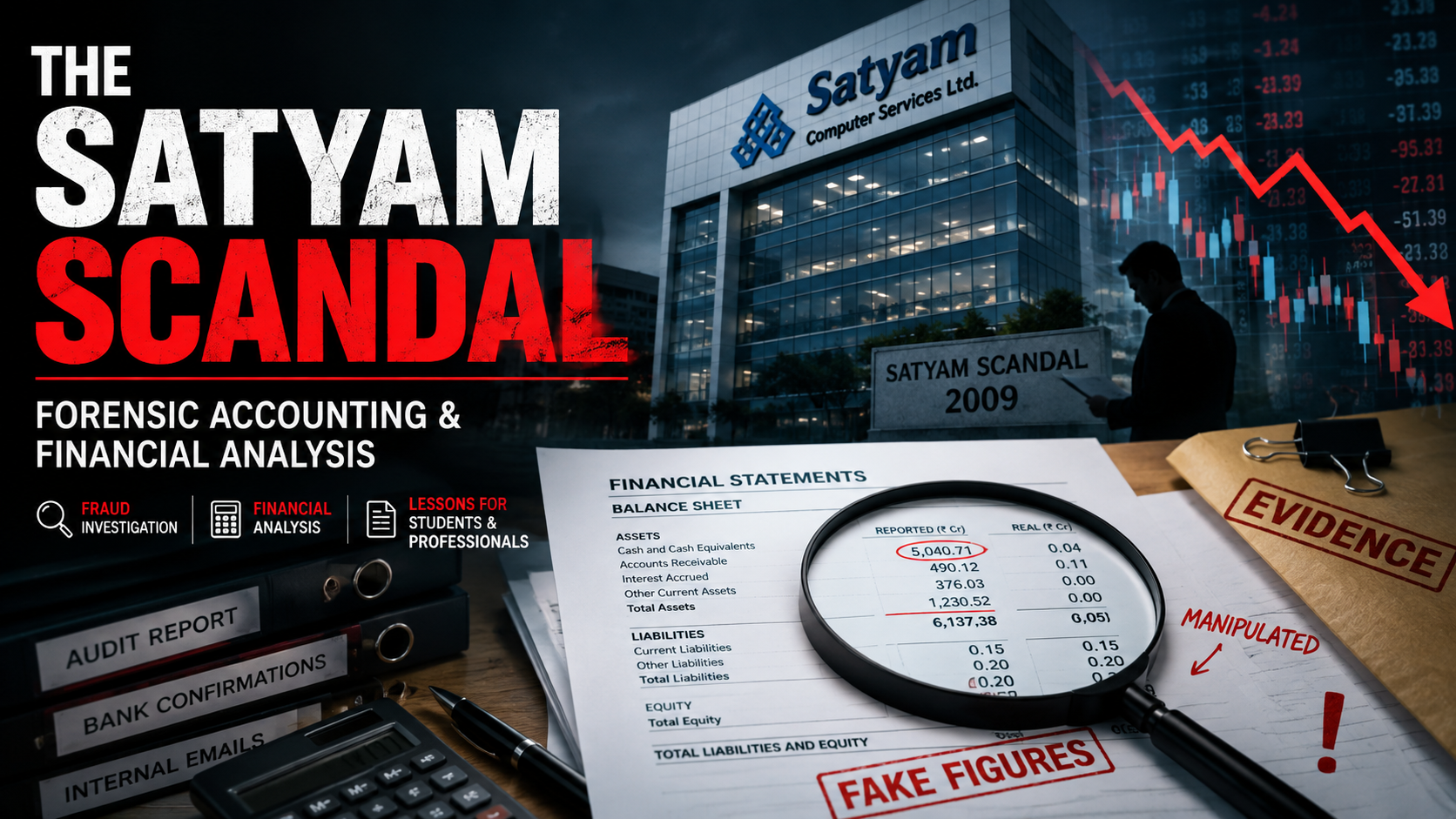
Satyam Case Study: Forensic Accounting Analysis
What Is the Satyam Case?
The Satyam case is one of India's most significant corporate accounting-fraud case studies, involving the manipulation of financial information at Satyam Computer Services.
On January 7, 2009, founder and chairman B. Ramalinga Raju disclosed irregularities in the company's accounts. His admission revealed that reported financial figures had been materially overstated, including cash and bank balances, accrued interest and other financial information.
The case became a major example of the risks associated with financial statement fraud, weak internal controls, inadequate oversight, auditor dependence on management representations, and corporate-governance failures.
For students studying financial analysis, the case is particularly valuable because it demonstrates why reported profit should be examined alongside cash flows, receivables, liabilities, margins and other financial indicators.
Who Should Study the Satyam Case?
The Satyam case is useful for anyone learning how financial statements can be analysed critically.
Target Learners
-
Accounting students studying financial reporting and auditing
-
Finance students learning fundamental analysis
-
CA, CMA and CFA aspirants studying corporate finance and accounting
-
NCFM learners studying fundamental analysis concepts
-
NISM candidates who want broader knowledge of financial markets and investor protection
-
Equity research professionals evaluating company financial statements
-
Auditors and forensic accounting professionals
-
Investors who want to understand financial-statement red flags
NISM is established by the Securities and Exchange Board of India (SEBI) and conducts certification examinations and professional-development activities for securities-market participants.
What Happened in the Satyam Scandal?
The core issue was the creation of a misleading picture of Satyam's financial performance and financial position.
The 2009 disclosure identified major discrepancies in reported financial information. Contemporary reporting on Raju's statement reported approximately ₹5,040 crore of non-existent cash and bank balances, ₹376 crore of accrued interest, an overstated debtors position of ₹490 crore and an understated liability of ₹1,230 crore.
The figures are important because they demonstrate how manipulation across several financial-statement items can significantly change the apparent financial health of a company.
Major Areas of Concern
| Financial Area | Reported Issue | Analytical Concern |
|---|---|---|
| Cash and bank balances | Inflated balances | Independent bank confirmation |
| Revenue | Financial performance overstated | Revenue verification |
| Receivables | Debtors overstated | Collection and confirmation analysis |
| Liabilities | Certain liabilities understated | Completeness testing |
| Interest income | Interest reported on balances that were not genuine | Bank reconciliation |
| Financial statements | Overall financial position distorted | Cross-statement analysis |
The case therefore provides a practical example of why analysts should not evaluate a company based only on its reported earnings.
Satyam Case Timeline: When Did It Happen?
Understanding the timeline makes the case easier to analyse.
Key Events
2009 — Disclosure: On January 7, 2009, Ramalinga Raju disclosed accounting irregularities at Satyam.
January 2009 — Regulatory action: Indian authorities began investigations into the company's financial statements and related matters.
January 2009 — New board: The Government moved to replace the existing board and appointed new directors to help stabilise the company.
2009 — Investigation: Agencies including SEBI, SFIO and CBI examined different aspects of the case.
April 2009 — Acquisition: Tech Mahindra emerged as the successful strategic investor through the government-approved process, leading to the eventual integration of Satyam into Tech Mahindra.
The Government of India documented the appointment of a new board and the investigation into the affairs of Satyam following the disclosure.
Forensic Accounting Analysis of Satyam
Forensic accounting is the use of accounting, auditing and investigative techniques to identify financial irregularities and analyse evidence.
The Satyam case illustrates several important forensic-accounting techniques.
1. Independent Bank Confirmation
Cash and bank balances should be independently verified with banks.
A forensic accountant should not rely entirely on documents supplied by management when independent evidence is available.
The investigation examined bank statements and fixed-deposit documentation, including findings concerning fabricated financial documents. SEBI's orders provide detailed regulatory records relating to the investigation.
2. Revenue Verification
Revenue is a fundamental component of financial analysis.
A forensic review can compare reported revenue with:
-
Customer contracts
-
Invoices
-
Delivery records
-
Timesheets
-
Customer confirmations
-
Bank receipts
-
Tax records
The objective is to determine whether reported transactions actually occurred and whether revenue was recognised appropriately.
3. Receivables Analysis
Receivables are amounts owed to a company by customers for goods or services already provided.
Analysts should investigate receivables when they grow significantly faster than revenue or cash collections.
Important tests include:
-
Customer confirmations
-
Receivables ageing
-
Subsequent cash collections
-
Credit notes
-
Bad-debt provisions
-
Revenue-to-receivables comparison
The Satyam disclosure specifically identified an overstated debtors position, making receivables an important analytical area.
Financial Analysis: Red Flags to Look For
The Satyam case demonstrates why fundamental analysis should go beyond the income statement.
Profit vs. Cash Flow
A company can report strong accounting profits without generating corresponding operating cash flow.
A useful analytical question is:
Are reported profits being converted into actual cash?
Persistent differences between profit and operating cash flow deserve investigation.
Revenue vs. Receivables
Revenue growth accompanied by disproportionately high receivables may require further examination.
For example:
Revenue ↑ significantly + Receivables ↑ faster + Cash collections remain weak = potential red flag
This does not automatically prove fraud, but it indicates that the analyst should investigate the underlying business explanation.
Cash Balance Verification
Reported cash is one of the most important balance-sheet items because it directly affects liquidity analysis.
A fundamental analyst should consider:
-
Cash balance
-
Bank deposits
-
Operating cash flow
-
Interest income
-
Debt
-
Short-term investments
These relationships can help identify inconsistencies.
Why Does the Satyam Case Matter?
The Satyam case matters because it demonstrates how financial reporting quality can affect investors, employees, creditors, regulators and the broader capital market.
For Investors
Investors should analyse:
-
Revenue quality
-
Profitability
-
Operating cash flow
-
Receivables
-
Debt
-
Working capital
-
Related-party transactions
-
Auditor observations
-
Corporate governance
For Finance Professionals
The case highlights the importance of:
-
Professional skepticism
-
Independent verification
-
Internal controls
-
Financial-statement analysis
-
Ethical conduct
-
Corporate governance
For Regulators
The case illustrates why securities-market regulators such as SEBI need effective disclosure, surveillance, enforcement and investor-protection mechanisms.
SEBI's investigation and subsequent proceedings provide an important primary-source record for studying the regulatory dimension of the case.
Corporate Governance Lessons from Satyam
Corporate governance refers to the systems through which a company is directed, controlled and monitored.
The Satyam case demonstrates why governance cannot depend solely on formal structures.
Effective governance requires:
-
An independent and effective board
-
A strong audit committee
-
Independent verification
-
Reliable internal controls
-
Effective whistleblower mechanisms
-
Transparent disclosure
-
Management accountability
-
Professional skepticism from auditors
The central lesson is that governance mechanisms must operate effectively, not merely exist on paper.
How Can You Study the Satyam Case?
A structured approach makes the case easier to understand and remember.
Step 1: Understand Financial Statements
Study the income statement, balance sheet and cash-flow statement.
Step 2: Learn Fundamental Analysis
Understand revenue, profitability, margins, working capital, liquidity and cash conversion.
For additional preparation, learners can use the NCFM Fundamental Analysis Module Workbook as a related study resource.
Step 3: Identify Red Flags
Practise identifying unusual relationships between:
-
Revenue and receivables
-
Profit and cash flow
-
Cash and interest income
-
Debt and liquidity
-
Growth and operating performance
Step 4: Study Forensic Techniques
Learn how independent confirmation, reconciliation, document examination and transaction testing can identify inconsistencies.
Step 5: Practise Questions
Use structured practice to test your understanding of accounting and financial-analysis concepts.
PassNISM provides practice resources for NISM, NCFM and other finance-related examinations, including a NCFM Fundamental Analysis Mock Test and other subject-wise practice tests.
You can also explore the PassNISM Practice Test platform for exam-style practice and answer analysis.
For learners preparing across securities-market subjects, the PassNISM mock-test exam-trends includes NISM and NCFM-related preparation resources.
Important Terms in the Satyam Case
Forensic Accounting: Investigative use of accounting and auditing techniques to identify financial irregularities.
Financial Statement Fraud: Deliberate manipulation or misrepresentation of financial information.
Receivables: Amounts owed by customers to a company.
Internal Control: Policies and procedures designed to protect assets and improve the reliability of financial information.
Corporate Governance: The framework used to direct, control and oversee a company.
Professional Skepticism: A questioning mindset that requires critical evaluation of audit evidence.
Fundamental Analysis: Evaluation of a company's financial and economic fundamentals to assess its business and investment characteristics.
Candidate Questions: Quick Answers
Q.1 What is the Satyam case?
Ans: The Satyam case is a major Indian corporate-accounting fraud case involving manipulation of financial information at Satyam Computer Services.
Q.2 Who was responsible for the Satyam accounting fraud?
Ans: B. Ramalinga Raju, Satyam's founder and chairman, publicly admitted accounting irregularities in January 2009. The subsequent investigations examined the conduct and responsibilities of multiple individuals and entities.
Q.3 When did the Satyam scandal become public?
Ans: The scandal became public on January 7, 2009, when Ramalinga Raju disclosed accounting irregularities.
Q.4 Why is Satyam important for forensic accounting?
Ans: Satyam is important because it demonstrates how independent verification, financial analysis, internal controls and forensic investigation can be used to identify inconsistencies in reported financial information.
Q.5 What can investors learn from the Satyam case?
Ans: Investors can learn to compare reported profits with operating cash flow, examine receivables, evaluate financial ratios, investigate unusual growth and assess corporate governance.
Q.6 Is the Satyam case relevant to fundamental analysis?
Ans: Yes. The case is highly useful as an educational example because fundamental analysis requires investors to examine the quality and consistency of financial information rather than relying on a single reported metric.
Key Takeaways:
-
The Satyam scandal is a landmark Indian corporate-fraud case study.
-
Financial statement analysis should go beyond reported profit.
-
Cash, receivables, revenue and liabilities require careful evaluation.
-
Forensic accounting relies heavily on independent evidence and investigation.
-
Strong internal controls and corporate governance are critical.
-
Investors should compare accounting profits with actual cash generation.
-
Fundamental analysis can help identify unusual financial relationships, although a red flag alone does not establish fraud.
-
SEBI and other authorities play an important role in securities-market oversight and investor protection.
-
The Satyam case remains relevant for students, finance professionals, auditors, analysts and investors.
Official Sources and Further Reading
For authoritative regulatory information, readers should consult the SEBI official website and NISM official certification resources. NISM states that it performs functions delegated under the SEBI framework relating to certification examinations and continuing professional education for securities-market participants.
Editorial note: This article is an educational synthesis of publicly available information and is not a substitute for primary regulatory orders, court records, statutory filings, audit documentation or official study material.