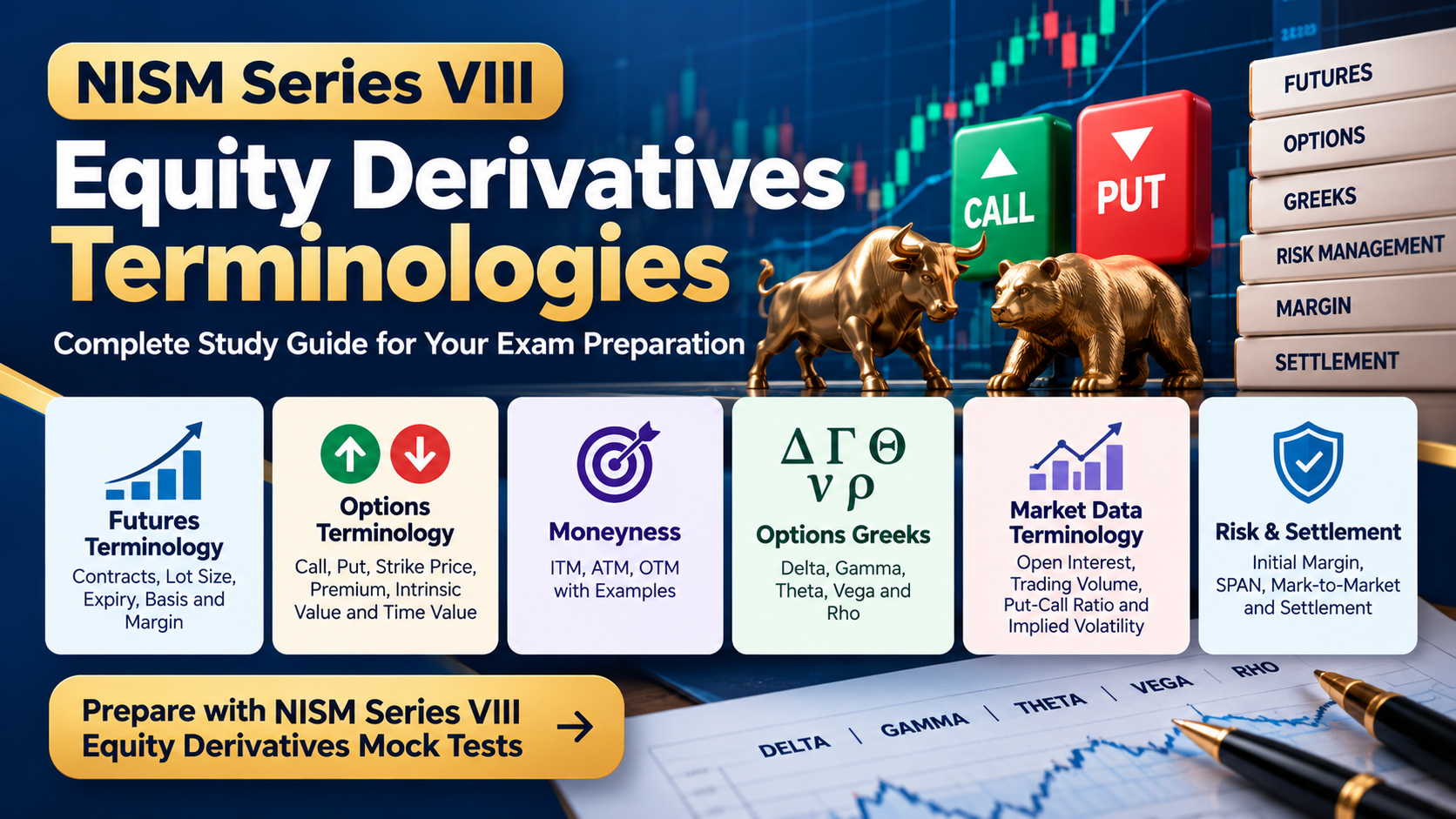
Preparing for the NISM-Series-VIII: Equity Derivatives Certification Examination? Understanding important equity derivatives terminologies is an essential step in your preparation. Concepts such as futures contracts, options, strike price, option premium, open interest, moneyness and Option Greeks frequently appear in derivatives study material and practice questions.
Learning these terms with simple examples can make complex topics easier to understand and help you approach exam questions with greater confidence.
In this guide, we explain important NISM Series VIII terminology in simple language, covering basic derivatives concepts, futures, options, market indicators, risk management and settlement.
Want to test your knowledge as you study? Practise with the NISM Series VIII Equity Derivatives Mock Tests on PassNISM.
1. Basic Equity Derivatives Terminology
Derivative
A derivative is a financial contract whose value depends on an underlying asset, index, rate or other reference variable. Equity derivatives commonly use individual shares or stock indices as their underlying assets.
Underlying Asset
The underlying asset is the financial instrument or reference value on which a derivative contract is based.
Example: If an options contract is based on a particular company's shares, those shares are the underlying asset.
Equity Derivatives
Equity derivatives are financial contracts linked to individual equities or equity indices. Futures and options are two important types of equity derivatives.
Hedging
Hedging means taking a position intended to reduce the risk of an existing investment or exposure.
Example: A portfolio manager who is concerned about a possible market decline may use index futures to help offset some of the portfolio's market risk.
Speculation
Speculation involves taking a market position in anticipation of a price movement to seek a profit. Unlike hedging, the primary purpose is to benefit from an expected change in market prices.
Arbitrage
Arbitrage involves seeking to profit from price differences between related instruments or markets. Such opportunities may be short-lived and can involve transaction costs and execution risks.
Long Position
A long position in a futures contract generally benefits when the futures price rises.
Short Position
A short position in a futures contract generally benefits when the futures price falls.
Remember that a futures position creates obligations for both parties, and losses can be substantial.
2. Important Futures Terminology
Forward Contract
A forward is a privately negotiated agreement between two parties to buy or sell an asset at a specified price on a future date. Terms can be customised, but counterparty risk may be significant.
Futures Contract
A futures contract is a standardised agreement traded on an exchange to buy or sell an underlying asset at a specified price under the contract's terms.
Lot Size
Lot size is the number of units of the underlying asset represented by one derivatives contract.
Example: If a hypothetical contract has a lot size of 500 shares, one contract represents 500 shares of exposure. Actual lot sizes depend on the exchange's current contract specifications.
Expiry Date
The expiry date is the date on which a derivatives contract expires according to its specifications.
Futures Price
The futures price is the price at which a futures contract is quoted or traded.
Spot Price
The spot price is the current market price of the underlying asset for immediate delivery or settlement, depending on the market convention.
Basis
Basis is commonly defined in equity futures as:
Basis = Spot Price − Futures Price
For example, if the spot price is ₹1,000 and the futures price is ₹1,012, the basis is −₹12.
Always check the definition used in the relevant question, as some contexts may express the difference in the opposite direction.
Cost of Carry
Cost of carry refers to the costs and benefits associated with holding an asset over time. Depending on the asset and market, these may include financing costs, dividends and other carrying benefits or expenses.
Convergence
Convergence refers to the tendency of futures and spot prices to move closer together as the futures contract approaches expiry, subject to the relevant contract and market conditions.
Mark-to-Market (MTM)
Mark-to-market is the process of valuing a position at current market prices and accounting for gains or losses according to the applicable settlement rules.
Margin
Margin is collateral required to support a derivatives position. It helps manage the risk that a participant may fail to meet financial obligations.
3. Important Options Terminology
Call Option
A call option gives the buyer the right, but not the obligation, to buy the underlying asset at the strike price under the contract's terms.
A call buyer generally benefits from a sufficiently large increase in the underlying price, after accounting for the premium and other costs.
Put Option
A put option gives the buyer the right, but not the obligation, to sell the underlying asset at the strike price under the contract's terms.
A put buyer generally benefits from a sufficiently large decline in the underlying price, after accounting for the premium and other costs.
Option Buyer
The option buyer pays the premium to obtain the contractual right. The buyer's loss on the option itself is generally limited to the premium paid, excluding transaction costs.
Option Writer
The option writer receives the premium and takes on the corresponding contractual obligation. Depending on the position and settlement terms, the writer may face substantial losses.
Strike Price
The strike price is the price specified in an options contract at which the underlying asset can be bought or sold under the option's terms.
Option Premium
The option premium is the price paid by the option buyer and received by the option writer.
Premiums are influenced by factors such as the underlying price, strike price, time to expiry, volatility, interest rates and expected dividends.
Expiry
Expiry is the point at which an option contract ends under its terms. Its value and settlement depend on the underlying price, strike price and applicable contract rules.
Intrinsic Value
Intrinsic value represents the immediate exercise value of an option, without considering its remaining time value.
For a call option:
Intrinsic Value = Maximum (Spot Price − Strike Price, 0)
For a put option:
Intrinsic Value = Maximum (Strike Price − Spot Price, 0)
Time Value
Time value is the portion of an option premium above its intrinsic value.
Time Value = Option Premium − Intrinsic Value
An option's time value generally declines as expiry approaches, all else being equal.
4. Moneyness of an Option: ITM, ATM and OTM
Moneyness describes the relationship between an option's strike price and the current price of the underlying asset.
Assume the underlying share is trading at ₹1,000.
| Term | Call option | Put option |
|---|---|---|
| In-the-Money (ITM) | Strike below ₹1,000 | Strike above ₹1,000 |
| At-the-Money (ATM) | Strike near ₹1,000 | Strike near ₹1,000 |
| Out-of-the-Money (OTM) | Strike above ₹1,000 | Strike below ₹1,000 |
In-the-Money (ITM)
An option is in-the-money when it has positive intrinsic value.
At-the-Money (ATM)
An option is at-the-money when the strike price is equal or close to the underlying price. The exact strike designated as ATM may depend on the exchange's contract specifications.
Out-of-the-Money (OTM)
An option is out-of-the-money when it has no intrinsic value.
Exam tip: Remember that calls and puts have opposite strike-price relationships when identifying ITM and OTM options.
5. Options Greeks: Delta, Gamma, Theta, Vega and Rho
Option Greeks measure how an option's theoretical price responds to changes in different factors. They are important for understanding options pricing and managing derivatives risk.
Delta (Δ)
Delta measures the estimated change in an option's price for a small change in the underlying asset price, with other factors held constant.
Example: If a call option has a Delta of 0.50, a ₹1 increase in the underlying price corresponds to an approximate ₹0.50 increase in the option premium, all else being equal.
Gamma (Γ)
Gamma measures how much Delta changes when the underlying asset price changes.
A higher Gamma means Delta can change more quickly as the underlying price moves.
Theta (Θ)
Theta measures the estimated change in an option's price as time passes, with other factors held constant.
Theta is commonly associated with time decay. Long options positions often have negative Theta, although the precise value depends on the option and pricing conditions.
Vega (ν)
Vega measures the sensitivity of an option's price to a change in implied volatility.
For many standard long call and long put positions, higher implied volatility increases the option's theoretical premium, all else being equal.
Rho (ρ)
Rho measures an option's sensitivity to changes in interest rates.
For standard options, a rise in interest rates generally has a positive effect on call values and a negative effect on put values, all else being equal.
Quick revision: Delta = underlying price sensitivity; Gamma = Delta sensitivity; Theta = time sensitivity; Vega = volatility sensitivity; Rho = interest-rate sensitivity.
For a focused explanation, read our guide to Options Greeks for NISM Series VIII: Delta, Gamma, Theta and Vega.
6. Important Market Data Terminology
Open Interest (OI)
Open interest is the total number of outstanding derivatives contracts that have not been closed, exercised or settled.
Open interest is different from trading volume. A contract can be traded multiple times during a session, so volume measures trading activity while open interest measures outstanding contracts.
Trading Volume
Trading volume is the number of contracts traded during a specified period.
Put-Call Ratio (PCR)
The put-call ratio compares put-related activity with call-related activity using a defined measure, such as volume or open interest.
The ratio must be interpreted in context. It is not a guaranteed indicator of future market direction.
Implied Volatility (IV)
Implied volatility is the volatility level implied by an option's market price under an options pricing model.
It reflects market pricing expectations and can change with supply, demand and market conditions. It is not a guarantee of future realised volatility.
Bid Price
The bid price is the price a buyer is currently willing to pay.
Ask Price
The ask price is the price at which a seller is currently willing to sell.
Bid-Ask Spread
The bid-ask spread is the difference between the ask price and the bid price. A narrower spread can indicate lower transaction costs, although liquidity and execution conditions still matter.
7. Risk Management and Settlement Terminology
Clearing Corporation
A clearing corporation facilitates clearing and settlement and manages specified risks associated with exchange-traded transactions under the applicable framework.
Settlement
Settlement is the process through which contractual obligations are fulfilled. The applicable process depends on the type of derivatives contract and the exchange's rules.
Initial Margin
Initial margin is collateral required to establish or maintain a position against potential future losses.
SPAN Margin
SPAN is a risk-based margining system used to calculate margin requirements for derivatives portfolios under the applicable framework.
Position Limit
A position limit restricts the size of positions that a participant may hold under specified rules.
Counterparty Risk
Counterparty risk is the possibility that the other party to a financial contract will fail to meet its obligations. Exchange clearing arrangements are designed to manage specified risks, but market and operational risks still remain.
8. Quick Revision Table for NISM Series VIII
| Terminology | Meaning to remember |
|---|---|
| Derivative | Contract whose value depends on an underlying asset or reference variable |
| Futures | Standardised exchange-traded contract |
| Call option | Right to buy |
| Put option | Right to sell |
| Strike price | Contractually specified exercise price |
| Premium | Price paid by the option buyer |
| ITM | Option has positive intrinsic value |
| ATM | Strike is equal or close to the underlying price |
| OTM | Option has no intrinsic value |
| Delta | Sensitivity to underlying price |
| Gamma | Sensitivity of Delta |
| Theta | Sensitivity to time passing |
| Vega | Sensitivity to implied volatility |
| Rho | Sensitivity to interest rates |
| Open interest | Outstanding contracts |
| Volume | Contracts traded during a period |
| Basis | Commonly spot price minus futures price |
| MTM | Valuing positions at current market prices |
| Hedging | Reducing an existing exposure to risk |
| Arbitrage | Seeking to benefit from price differences |
9. Practice Questions: Test Your Understanding
Q1. Which Greek measures an option's sensitivity to changes in implied volatility?
A. Delta
B. Gamma
C. Theta
D. Vega
Answer: D. Vega. Vega measures the estimated sensitivity of an option's theoretical value to implied volatility.
Q2. Which option gives its buyer the right to sell the underlying asset at the strike price?
A. Call option
B. Put option
C. Futures contract
D. Forward contract
Answer: B. Put option. A put gives the buyer the right to sell under the contract's terms.
Q3. What does open interest measure?
A. All shares held by investors
B. Total outstanding derivatives contracts
C. The day's highest option premium
D. Total number of market participants
Answer: B. Total outstanding derivatives contracts. Open interest measures contracts that remain open, not all contracts traded during the day.
Q4. Which Greek measures how Delta changes as the underlying price changes?
A. Gamma
B. Vega
C. Rho
D. Theta
Answer: A. Gamma. Gamma measures the rate at which Delta changes with the underlying price.
Q5. A share trades at ₹1,000. A call option has a strike price of ₹950. What is its intrinsic value?
A. ₹0
B. ₹25
C. ₹50
D. ₹950
Answer: C. ₹50. Call intrinsic value is the maximum of spot price minus strike price and zero: ₹1,000 − ₹950 = ₹50.
Q6. What does Theta generally describe?
A. Sensitivity to interest rates
B. Sensitivity to time passing
C. Sensitivity to trading volume
D. Sensitivity of Delta to price
Answer: B. Sensitivity to time passing. Theta measures the estimated impact of the passage of time on option value, all else being equal.
Q7. What is the primary purpose of hedging?
A. To guarantee a profit
B. To eliminate every form of risk
C. To reduce a specified risk exposure
D. To increase trading volume
Answer: C. To reduce a specified risk exposure. Hedging can reduce a particular exposure but does not eliminate all risks or guarantee a profit.
10. How to Prepare for the NISM-Series-VIII: Equity Derivatives Examination
Use the following approach to improve your understanding of derivatives terminology:
-
Study the official workbook: Follow the current NISM syllabus and prescribed study material.
-
Learn definitions with examples: Connect each term to a practical situation rather than memorising isolated words.
-
Practise calculations: Revise option intrinsic value, break-even points, futures payoffs and basic pricing concepts.
-
Review Options Greeks: Understand what each Greek measures and how it responds to changes in underlying price, time, volatility and interest rates.
-
Attempt mock tests: Use practice questions to identify weak topics, review mistakes and improve time management.
For additional practice, visit the NISM-Series-VIII: Equity Derivatives Mock Tests on PassNISM. You can begin with the available free practice test and use your results to identify topics that need further revision.
Frequently Asked Questions
What are the important terminologies in NISM Series VIII?
Important terms include futures, options, strike price, premium, expiry, intrinsic value, time value, moneyness, Delta, Gamma, Theta, Vega, Rho, open interest, implied volatility, margin and mark-to-market.
What are the five main Options Greeks?
The five commonly discussed Greeks are Delta, Gamma, Theta, Vega and Rho. They measure sensitivity to underlying price, Delta, time, implied volatility and interest rates, respectively.
What is the difference between open interest and volume?
Volume measures contracts traded during a period. Open interest measures outstanding contracts that remain open.
Why should I learn derivatives terminology before attempting mock tests?
Understanding terminology makes it easier to interpret questions, apply formulas, compare strategies and identify the risks associated with futures and options.
Where can I practise NISM Series VIII questions?
You can use the PassNISM NISM Series VIII Equity Derivatives Mock Tests to practise questions and assess your understanding.
Conclusion
Understanding equity derivatives terminology is a foundation for preparing for the NISM-Series-VIII: Equity Derivatives Certification Examination. From futures contracts and option premiums to moneyness, Options Greeks, open interest and margining, each concept contributes to a broader understanding of the derivatives market.
Study the definitions, practise numerical examples and review your mistakes regularly. Combine this guide with the official NISM workbook and structured mock-test practice to strengthen your preparation.
Ready to practise? Start with the NISM Series VIII Equity Derivatives Mock Tests on PassNISM.