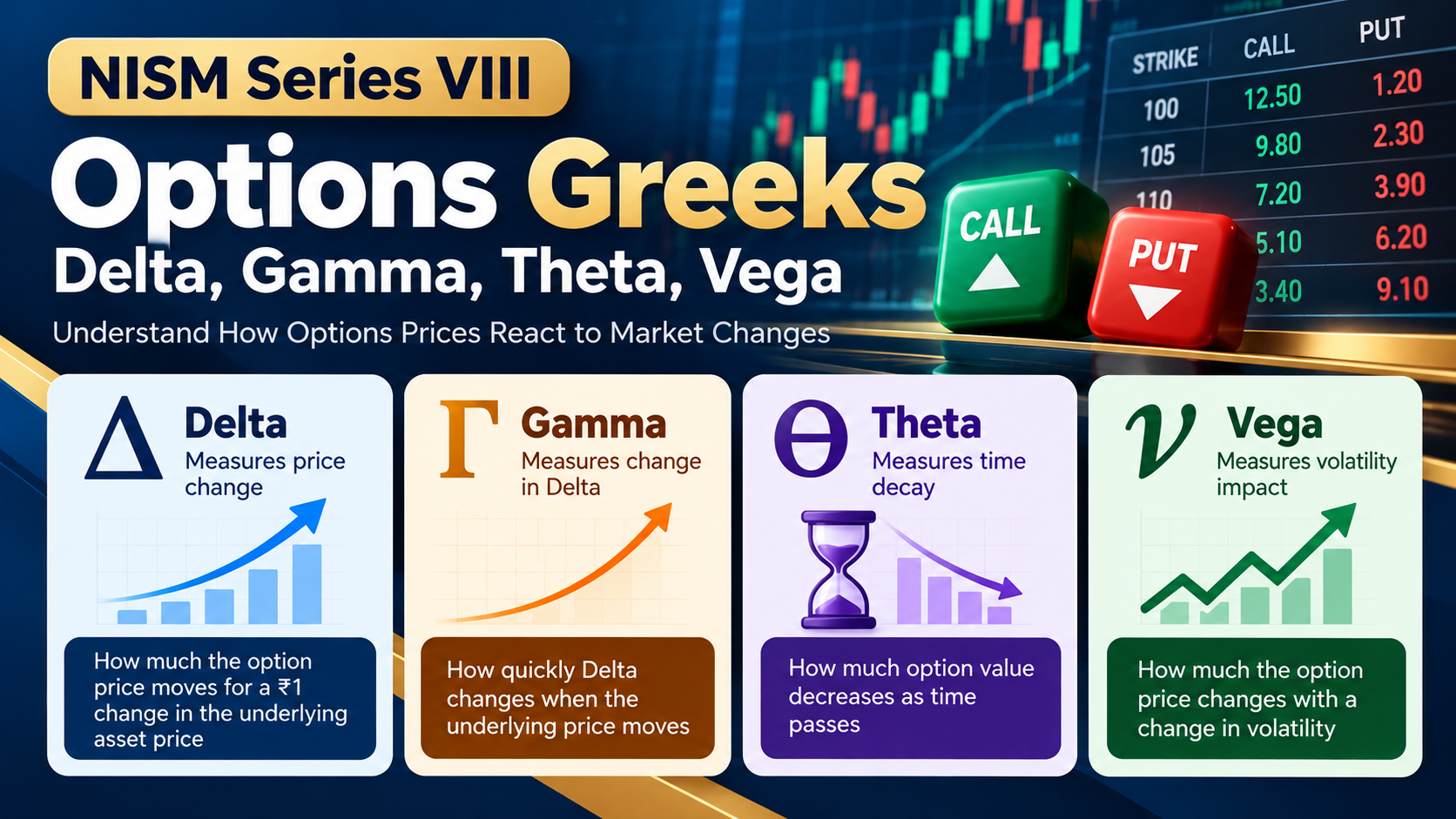
Options Greeks for NISM VIII: Delta, Gamma, Theta & Vega Explained with Worked Examples
What are options Greeks, and why does NISM Series VIII test them?
An option’s premium is never fixed. It moves every second because the underlying price moves, time passes, volatility changes and interest rates shift. The Greeks put a number on each of those sensitivities. Traders, risk managers and dealers use them to understand what could happen to a position before it happens.
The NISM Series VIII (Equity Derivatives) certification is meant for people who deal in equity derivatives on Indian exchanges. Greeks are part of the options material, and exam questions usually test direction, sign and interpretation more than heavy calculation. Always confirm the exact chapter coverage against the latest official NISM workbook, because syllabus details can be revised.
All prices in this article are illustrative figures chosen to make the arithmetic easy. They are not live market data, and the lot size used is a teaching assumption, so check the current contract specifications on the exchange website before trading.
What makes up an option premium?
Before the Greeks make sense, you need the premium itself clear.
- Premium = intrinsic value + time value.
- Intrinsic value of a call = the larger of (spot price − strike price) and 0.
- Intrinsic value of a put = the larger of (strike price − spot price) and 0.
- Time value is whatever is left of the premium after intrinsic value. It reflects the chance that the option gets more valuable before expiry.
Example: XYZ Ltd trades at ₹520. A 500 call has a premium of ₹32. Intrinsic value = 520 − 500 = ₹20, so time value = 32 − 20 = ₹12.
|
Moneyness |
Call option |
Put option |
|---|---|---|
|
In the money (ITM) |
Spot above strike |
Spot below strike |
|
At the money (ATM) |
Spot equal (or very near) to strike |
Spot equal (or very near) to strike |
|
Out of the money (OTM) |
Spot below strike |
Spot above strike |
What factors affect an option’s price?
The Greeks exist because these factors move the premium. Here is the direction of each effect, holding everything else constant.
|
Factor increases |
Call premium |
Put premium |
|---|---|---|
|
Spot price of the underlying |
Rises |
Falls |
|
Strike price (for a given underlying) |
Lower |
Higher |
|
Time to expiry |
Generally rises |
Generally rises |
|
Volatility |
Rises |
Rises |
|
Interest rate |
Rises |
Falls |
|
Expected dividends |
Falls |
Rises |
The next five sections take each factor’s sensitivity in turn.
What is Delta?
Delta is the change in an option’s premium for a ₹1 change in the price of the underlying.
Formula in single-line form: Change in premium ≈ Delta × Change in underlying price
Delta ranges and signs
- A call has a Delta between 0 and +1. It gains value when the underlying rises.
- A put has a Delta between −1 and 0. It gains value when the underlying falls.
- An ATM option has a Delta of roughly 0.5 (calls) or −0.5 (puts).
- A deep ITM option’s Delta moves toward +1 (call) or −1 (put). It starts behaving like the underlying itself.
- A deep OTM option’s Delta moves toward 0. The underlying hardly moves its premium.
|
Option |
Call Delta (approx.) |
Put Delta (approx.) |
|---|---|---|
|
Deep ITM |
Close to +1 |
Close to −1 |
|
ATM |
About +0.5 |
About −0.5 |
|
Deep OTM |
Close to 0 |
Close to 0 |
Useful relationship: For a call and a put with the same underlying, strike and expiry, the absolute Delta of the put is roughly 1 minus the Delta of the call. If a call has a Delta of 0.60, the matching put has a Delta of about −0.40.
Worked example 1: Delta of a call
XYZ Ltd is at ₹500. The 500 call has a premium of ₹20 and a Delta of 0.50. One lot is 1,000 shares (illustrative).
- Spot rises by ₹10: change in premium ≈ 0.50 × 10 = ₹5, so the new premium is about ₹25.
- Spot falls by ₹10: change in premium ≈ 0.50 × (−10) = −₹5, so the new premium is about ₹15.
- Profit on one long lot if spot rises ₹10 ≈ ₹5 × 1,000 = ₹5,000.
Worked example 2: Delta of a put
The 500 put on XYZ Ltd has a premium of ₹18 and a Delta of −0.45.
- Spot rises by ₹10: change in premium ≈ −0.45 × 10 = −₹4.50, so the new premium is about ₹13.50.
- Spot falls by ₹10: change in premium ≈ −0.45 × (−10) = +₹4.50, so the new premium is about ₹22.50.
Delta as a rough probability
Market participants often read Delta as a rough guide to the chance that an option finishes in the money. A call with a Delta of 0.30 is treated as having roughly a 30 percent chance. It is a rule of thumb, not an exact probability, so do not treat it as one in an exam answer.
What is Gamma?
Gamma is the rate of change of Delta for a ₹1 change in the price of the underlying. Delta is not constant. Gamma tells you how quickly it changes.
- Gamma is positive for anyone who is long an option (call or put) and negative for anyone who is short.
- Gamma is highest for ATM options close to expiry, because a small move can swing the option from probably worthless to probably valuable.
- Gamma is low for deep ITM and deep OTM options, because their Delta is already near its limit.
- A call and a put with the same strike, expiry and underlying have the same Gamma.
Worked example 3: Gamma changing Delta
An ATM call has a Delta of 0.50 and a Gamma of 0.04 (illustrative).
- Spot rises ₹5: new Delta ≈ 0.50 + (0.04 × 5) = 0.70.
- Spot falls ₹5: new Delta ≈ 0.50 − (0.04 × 5) = 0.30.
This is why a Delta-only estimate becomes less accurate for large moves. A closer estimate, shown here for understanding rather than as a likely exam calculation, is: Change in premium ≈ (Delta × move) + (0.5 × Gamma × move × move). For a ₹5 rise: (0.50 × 5) + (0.5 × 0.04 × 25) = 2.50 + 0.50 = ₹3.00, compared with ₹2.50 from Delta alone.
What is Theta?
Theta is the change in an option’s premium as one day passes, with everything else unchanged. It measures time decay.
- Theta is negative for long options (calls and puts). Time works against the buyer.
- Theta is positive for short options. Time works for the seller, who collects the decay.
- Time decay speeds up as expiry approaches, and it is largest for ATM options. OTM and ITM options lose less time value per day.
- At expiry, time value is zero. Only intrinsic value remains.
Worked example 4: Theta in action
An ATM call has a premium of ₹20 and a Theta of −₹0.80 per day (illustrative).
- After 1 day, with spot and volatility unchanged: premium ≈ 20 − 0.80 = ₹19.20.
- After 5 days: premium ≈ 20 − (0.80 × 5) = ₹16.00, assuming Theta stays constant.
In reality Theta grows in size as expiry nears, so the real loss over the last few days is bigger than a constant-Theta estimate. Use the constant figure only for exam arithmetic that tells you to assume it.
What is Vega?
Vega is the change in an option’s premium for a one percentage point change in implied volatility. Implied volatility is the market’s expectation of how much the underlying will move, backed out from option prices. India VIX is NSE’s published measure of expected market volatility.
- Vega is positive for long options and negative for short options. Higher volatility raises both call and put premiums.
- Vega is highest for ATM options and for longer-dated options, because there is more time for volatility to matter.
- Vega is close to zero for options about to expire.
- A call and a put with the same strike, expiry and underlying have the same Vega.
Worked example 5: Vega
An ATM call has a premium of ₹20 and a Vega of 0.30 (illustrative).
- Implied volatility rises from 20 percent to 24 percent: change in premium ≈ 0.30 × 4 = +₹1.20, so the premium is about ₹21.20.
- Implied volatility falls from 20 percent to 17 percent: change in premium ≈ 0.30 × (−3) = −₹0.90, so the premium is about ₹19.10.
This is why option buyers sometimes lose money even when the underlying moves in their favour. If implied volatility drops sharply, for example after a big scheduled event passes, the premium can fall.
What is Rho?
Rho is the change in an option’s premium for a one percentage point change in the interest rate.
- Rho is positive for calls and negative for puts.
- Rho matters more for longer-dated options and is usually the least significant Greek for short-dated index and stock options.
Options Greeks cheat sheet
|
Greek |
Measures sensitivity to |
Long call |
Long put |
Highest for |
|---|---|---|---|---|
|
Delta |
Price of the underlying |
Positive |
Negative |
Deep ITM options (in size) |
|
Gamma |
Change in Delta |
Positive |
Positive |
ATM options near expiry |
|
Theta |
Passage of time |
Negative |
Negative |
ATM options near expiry |
|
Vega |
Implied volatility |
Positive |
Positive |
ATM and longer-dated options |
|
Rho |
Interest rates |
Positive |
Negative |
Longer-dated options |
How do the Greeks look for long and short positions?
The table below is the most useful one to memorise. A short position flips the sign of every Greek of the matching long position.
|
Position |
Delta |
Gamma |
Theta |
Vega |
|---|---|---|---|---|
|
Long call |
Positive |
Positive |
Negative |
Positive |
|
Long put |
Negative |
Positive |
Negative |
Positive |
|
Short call |
Negative |
Negative |
Positive |
Negative |
|
Short put |
Positive |
Negative |
Positive |
Negative |
Two patterns make this easy to remember:
- Buyers are long Gamma and long Vega but pay Theta. They want a big move or a rise in volatility.
- Sellers collect Theta but are short Gamma and short Vega. They want a quiet market.
Worked example 6: All Greeks together
An ATM call on XYZ Ltd has a premium of ₹20, Delta 0.50, Vega 0.30 and Theta −₹0.80 per day. One day passes, spot rises ₹4 and implied volatility falls 2 points.
- Delta effect: 0.50 × 4 = +₹2.00
- Vega effect: 0.30 × (−2) = −₹0.60
- Theta effect: −₹0.80
- Net change ≈ 2.00 − 0.60 − 0.80 = +₹0.60, so the new premium is about ₹20.60.
Even though spot rose, the gain was much smaller than Delta alone suggested, because volatility and time both worked against the position.
What is Delta hedging?
A position’s Delta is the total number of underlying units it behaves like. To make a position Delta-neutral, take an opposite position in the underlying (or its futures) equal to that figure.
Formula in single-line form: Position Delta = Option Delta × Lot size × Number of lots (with a minus sign for short positions)
Worked example 7: Hedging a long call position
A trader is long 10 lots of an XYZ call. Delta is 0.60 and the lot size is 1,000 (illustrative).
- Position Delta = 0.60 × 1,000 × 10 = +6,000.
- To neutralise it, sell 6,000 shares, or sell 6 lots of XYZ futures (if one futures lot is 1,000 shares).
- Net Delta after the hedge ≈ 0.
Gamma means Delta keeps changing as the underlying moves, so a Delta hedge needs to be rebalanced. That is why professional hedging is described as dynamic.
Worked example 8: Hedging a short put position
A trader is short 5 lots of an XYZ put. Delta of the put is −0.40 and the lot size is 500 (illustrative).
- Position Delta = −(−0.40) × 500 × 5 = +1,000. A short put has positive Delta.
- To neutralise it, sell 1,000 shares or the equivalent futures.
What do the Greeks look like for a straddle?
A long straddle means buying a call and a put at the same strike and expiry. It is a bet on a big move in either direction.
Worked example 9: Long ATM straddle
XYZ Ltd is at ₹500. The 500 call costs ₹20 and the 500 put costs ₹18, so the combined premium is ₹38.
- Delta ≈ 0.52 + (−0.48) = +0.04, which is close to Delta-neutral at the start.
- Gamma and Vega are positive, because both legs are long.
- Theta is negative, because both legs lose time value every day.
- Breakeven points at expiry: 500 + 38 = ₹538 on the upside and 500 − 38 = ₹462 on the downside.
The straddle makes money only if the move is large enough to cover ₹38 of premium. A short straddle has the opposite Greeks (negative Gamma and Vega, positive Theta) and unlimited risk in theory, so exchanges require margin for it.
Common mistakes students make on Greeks questions
- Mixing up the sign of a put’s Delta. A long put has negative Delta. A short put has positive Delta.
- Forgetting that Gamma and Vega are positive for both long calls and long puts.
- Treating Theta as a loss for everyone. It is a gain for the option seller.
- Assuming ATM and deep ITM options behave alike. Delta is about 0.5 for ATM and near 1 for deep ITM.
- Using a one-point change when the question says a percentage-point change. Vega and Rho are quoted per one percentage point.
- Forgetting lot size when converting per-share figures into a position-level answer.
10 practice questions on options Greeks
- The Delta of a deep in-the-money call option approaches which value?
(a) 0
(b) +0.5
(c) +1
(d) −1
Answer: (c). A deep ITM call behaves almost like the underlying. - Which Greek measures the effect of the passage of time on an option’s premium?
(a) Delta
(b) Gamma
(c) Theta
(d) Vega
Answer: (c). Theta measures time decay. - Which of these is the same for a call and a put with the same underlying, strike and expiry? (a) Delta
(b) Gamma
(c) Rho
(d) Theta
Answer: (b). Gamma is the same for both, and so is Vega. - A call has a Delta of 0.65. The put with the same strike and expiry has a Delta of about:
(a) +0.35
(b) −0.35
(c) +0.65
(d) −0.65
Answer: (b). The put’s Delta is roughly the call’s Delta minus 1, which is −0.35. - Which position has negative Gamma and positive Theta?
(a) Long call
(b) Long put
(c) Long straddle
(d) Short straddle
Answer: (d). Any short option position has negative Gamma and positive Theta. - An option has a Vega of 0.25. Implied volatility rises by 3 percentage points. The premium changes by about:
(a) +₹0.25
(b) +₹0.75
(c) +₹3.00
(d) −₹0.75
Answer: (b). 0.25 × 3 = ₹0.75. - A long option has a Theta of −₹1.20 per day. Assuming nothing else changes and Theta is constant, the premium falls by about how much in 3 days?
(a) ₹0.40
(b) ₹1.20
(c) ₹3.60
(d) ₹4.80
Answer: (c). 1.20 × 3 = ₹3.60. - If interest rates rise, other things equal, call premiums generally:
(a) Fall
(b) Rise
(c) Stay unchanged
(d) Fall to zero
Answer: (b). Rho is positive for calls and negative for puts. - What is the sign of the Delta of a long put position?
(a) Positive
(b) Negative
(c) Zero
(d) Always +1
Answer: (b). Negative sign of the Delta of a long put position - A trader is long 4 lots of calls with a Delta of 0.50. The lot size is 250. To become Delta-neutral, the trader should:
(a) Buy 500 shares
(b) Sell 500 shares
(c) Sell 1,000 shares
(d) Do nothing
Answer: (b). Position Delta = 0.50 × 250 × 4 = +500, so sell 500 shares or the equivalent in futures.
Want more practice? Try the NISM Series VIII Equity Derivatives mock tests and the sample questions.
Frequently asked questions
Do I need to calculate Black-Scholes values by hand for NISM Series VIII?
Exam questions generally focus on understanding what each Greek measures, its sign and how it behaves, along with simple calculations like the ones in this article. Check the latest official workbook and the NISM exam page for the exact scope.
Which Greek is the most important to remember for the exam?
Delta, because it is the foundation of Delta hedging and position Delta questions. After that, make sure you can recite the sign table for long and short calls and puts.
What is the Delta of an at-the-money option?
Roughly 0.5 for a call and −0.5 for a put. It shifts slightly depending on time to expiry, volatility and interest rates.
Why do option sellers like Theta?
Theta is positive for sellers. If the underlying stays quiet, the option loses time value every day and the seller keeps that decay. The risk is a large move, which is why short Gamma is dangerous.
What is implied volatility, and how is it different from historical volatility?
Implied volatility is the volatility built into current option prices and reflects expectations. Historical volatility measures how much the underlying actually moved in the past.
Are the Greeks the same for index options and stock options?
The definitions and signs are identical. Contract specifications such as lot size, expiry cycle and settlement type differ, so check the exchange’s current rules.
Where to go next
- Revise the derivatives basics in the Introduction to Derivatives study notes.
- Study payoffs and strategies in the Options Contracts: Mechanism and Applications notes.
- Read the full preparation plan in How to Crack the NISM Equity Derivatives Exam on Your First Attempt.
- Practise under exam conditions with the NISM Series VIII mock test.
Sources and disclaimer
- NISM, National Institute of Securities Markets for the current exam details and workbook.
- NSE India for contract specifications, lot sizes and India VIX.
This article is educational and prepared for exam preparation. The prices, Greeks and lot sizes in the worked examples are illustrative and are not live market data or investment advice. Always confirm exam scope and contract specifications with official sources.