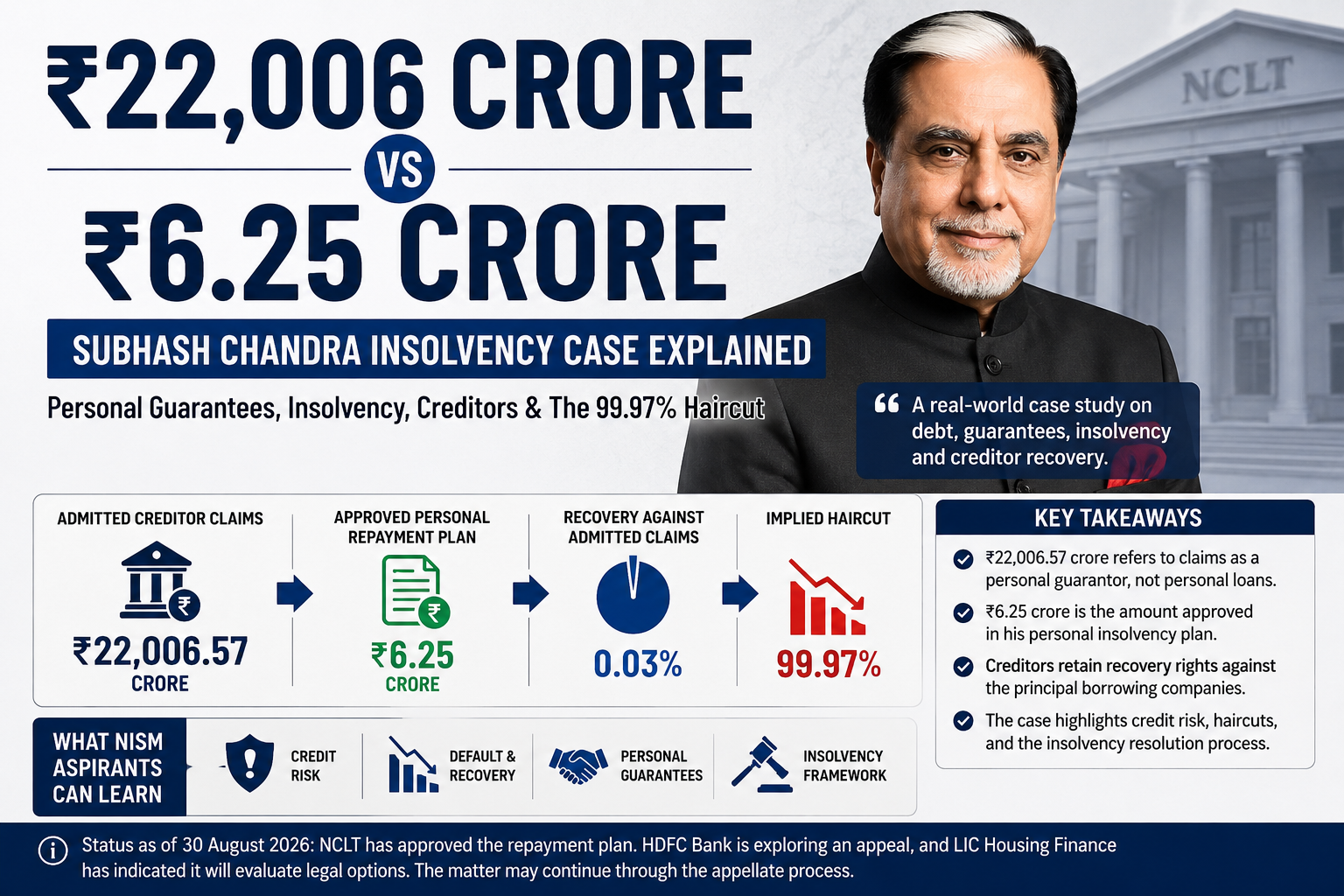
The recent insolvency proceedings involving Essel Group founder Subhash Chandra have attracted considerable attention because of one striking set of numbers: ₹22,006.57 crore in admitted creditor claims versus a repayment plan of approximately ₹6.25 crore.
At first glance, the numbers appear to suggest that ₹22,000 crore of debt has been settled for only ₹6 crore. But that description is incomplete.
The case is actually about personal guarantees provided by Subhash Chandra for borrowings by companies associated with the Essel Group, and not simply about ₹22,000 crore of loans personally borrowed by him. The distinction is important for understanding the case, the Insolvency and Bankruptcy Code (IBC), creditor recovery and the concept of a "haircut."
For finance professionals, investors and NISM certification candidates, the case provides a useful real-world example of credit risk, personal guarantees, insolvency resolution, creditor recovery, voting by creditors and haircuts.
Key takeaway: The headline figure of ₹22,006 crore should not be interpreted as a ₹22,006 crore personal bank loan being written off for ₹6.25 crore. The proceedings concern Chandra's liabilities as a personal guarantor, while the underlying corporate borrowers remain relevant to creditor recovery.
What Happened in the Subhash Chandra Insolvency Case?
The National Company Law Tribunal (NCLT) approved a repayment plan under which Subhash Chandra would contribute approximately ₹6.25 crore against admitted creditor claims of about ₹22,006.57 crore in his personal insolvency proceedings.
Reports calculate this as a recovery of roughly 0.03%, implying a haircut of approximately 99.97% when comparing the approved payment with the admitted claims in the personal-guarantor proceedings.
That headline number naturally raises a question:
How can ₹22,006 crore of claims result in a ₹6.25 crore repayment plan?
The answer requires understanding the difference between:
-
A corporate borrower
-
A personal guarantor
-
Admitted claims
-
The guarantor's personal assets
-
Corporate assets and liabilities
-
Insolvency resolution
-
Creditor recovery
₹22,006 Crore Was Not Simply a Personal Loan
This is the most important point to understand.
According to reporting based on the NCLT proceedings, the ₹22,006.57 crore figure represents claims connected with personal guarantees given by Subhash Chandra for loans taken by companies associated with the Essel Group. Government sources cited by The Economic Times specifically cautioned that the NCLT outcome should not be interpreted as banks writing off nearly ₹22,000 crore of corporate loans for ₹6 crore. The corporate borrowers remain liable, and creditors retain recovery avenues against those borrowers and their assets.
Chandra's office has separately disputed the way the ₹22,000-crore figure has been presented. It said he did not personally borrow money from lenders and that he had provided guarantees for loans taken by group-linked companies. His office said lenders that objected to the repayment plan had claims totaling about ₹3,992 crore against him as personal guarantor, of which ₹620 crore had been settled, leaving ₹3,372 crore according to its clarification.
Therefore, the safest way to describe the case is:
NCLT approved a personal-guarantor repayment plan involving ₹6.25 crore against admitted claims of approximately ₹22,006.57 crore.
That is considerably more accurate than saying:
"Subhash Chandra borrowed ₹22,000 crore and paid back ₹6 crore."
What Is a Personal Guarantee?
A personal guarantee is an undertaking by an individual to meet certain obligations of a borrower if the borrower fails to do so, subject to the terms of the guarantee and applicable law.
Consider a simplified example.
Suppose:
Company A borrows ₹500 crore from a bank.
The promoter provides a personal guarantee.
If Company A subsequently defaults, the lender may have rights arising from the guarantee against the guarantor, subject to the applicable legal framework.
This creates two distinct relationships:
| Party | Role |
|---|---|
| Company | Primary borrower |
| Bank/Financial Institution | Creditor |
| Promoter/Individual | Personal guarantor |
| Corporate assets | Potential source of recovery |
| Guarantor's assets | Potentially relevant to guarantee obligations |
This distinction is central to understanding the Subhash Chandra case.
Why Did the ₹6.25 Crore Figure Become Possible?
The answer is closely connected with the individual's available assets and the insolvency resolution framework.
According to the clarification issued by Chandra's office, his assets were valued at approximately ₹31.79 crore in 2024, including a residential property valued at around ₹25 crore. His office said the repayment plan was based on his available personal resources.
This is important because a creditor's claim and the amount that can actually be recovered from a particular debtor are not necessarily the same.
Imagine:
Creditor's claim = ₹1,000 crore
Recoverable value from the relevant debtor/guarantor = ₹20 crore
The legal claim may be very large, but the practical recovery can be much smaller if available assets and other recovery avenues are limited.
That difference between claim value and realizable recovery is an important concept in credit and insolvency analysis.
What Is a Haircut?
The term haircut is commonly used in banking and finance to describe a reduction in the value or amount recovered compared with the original claim or exposure.
In this case, media reports calculated the recovery against the admitted claims as approximately:
Admitted claims: ₹22,006.57 crore
Approved payment: ₹6.25 crore
Approximate recovery:
₹6.25 crore ÷ ₹22,006.57 crore × 100 ≈ 0.028%
So the implied reduction is approximately:
100% − 0.028% ≈ 99.972%
Rounded, this is approximately a 99.97% haircut on the admitted claims used in the comparison.
Important clarification
This calculation should not be interpreted as saying that banks have lost ₹22,000 crore permanently because of this single personal insolvency proceeding.
Creditors can continue to have rights against the principal borrowing companies and their assets, depending on the specific loans, securities, guarantees and legal proceedings involved.
Why Did Creditors Approve the Repayment Plan?
Another interesting aspect of the case is the voting process.
According to reporting on the NCLT order, creditors representing 80.814% of the votes cast supported Chandra's repayment plan, while creditors including HDFC Bank and LIC Housing Finance opposed it.
The approval therefore wasn't simply a unilateral decision by the debtor.
The insolvency framework provides a process through which creditors consider a repayment plan, followed by adjudication by the NCLT.
Under Section 114 of the Insolvency and Bankruptcy Code, the Adjudicating Authority may approve or reject a repayment plan based on the report of the creditors' meeting submitted by the resolution professional. Section 115 provides for the effect of an approved repayment plan, including its binding effect on the creditors and debtor covered by the plan.
This makes the case useful for understanding how an insolvency process differs from a simple private settlement between a borrower and a bank.
Why Did Some Banks Oppose the Plan?
Not all creditors were satisfied with the proposed recovery.
HDFC Bank has said it is exploring an appeal against the NCLT order. Its admitted claim represented about 3.2% of the total stated claims, according to reporting.
LIC Housing Finance also disclosed exposure in two loan accounts involving Chandra as personal guarantor. The company was reported to have an admitted claim of approximately ₹1,322.39 crore, while the approved plan would result in a payment of approximately ₹38.09 lakh to it. LIC Housing Finance said it retained its rights over secured assets and was also exploring its legal options.
This highlights an important principle in credit analysis:
A creditor evaluates not only the amount owed, but also the probability and amount of recovery.
The Role of Secured Assets
A lender may have security over assets in addition to a personal guarantee.
For example, a loan may be supported by:
-
Property
-
Shares
-
Receivables
-
Corporate assets
-
Guarantees
-
Other collateral
Therefore, even when the recovery from a particular personal-guarantor proceeding is very low, creditors may have separate recovery rights depending on the structure of the underlying transaction.
This is one reason why the phrase "₹22,000 crore debt settled for ₹6 crore" can be misleading when used without context.
What Does This Case Teach Us About Credit Risk?
The Subhash Chandra case provides several important lessons about credit risk.
1. A Large Loan Requires a Large Recovery Capacity
A lender may approve a large exposure based on the borrower's:
-
Cash flows
-
Assets
-
Business prospects
-
Credit history
-
Collateral
-
Guarantees
-
Group structure
But if the business deteriorates significantly, the value available for recovery can fall sharply.
2. Personal Guarantees Are Important
For lenders, a personal guarantee can provide an additional layer of credit support.
For promoters and business owners, however, signing a personal guarantee can create substantial personal financial exposure.
The guarantee may connect an individual's financial position with the borrowing company's obligations.
3. Recovery Is Not the Same as Exposure
Suppose a bank has:
Exposure = ₹100 crore
That does not automatically mean:
Loss = ₹100 crore
The lender may recover:
-
₹40 crore from collateral
-
₹20 crore from the borrower
-
₹10 crore from a guarantor
The ultimate loss would then depend on the total recovery and associated costs.
This distinction between exposure, recovery and loss is fundamental to credit-risk analysis.
The Difference Between Debt, Claim and Recovery
These terms are sometimes used interchangeably in news headlines, but they can mean different things.
Debt
An obligation to repay money.
Claim
The amount a creditor asserts or is entitled to claim in an insolvency proceeding, subject to verification and admission.
Recovery
The amount actually recovered by the creditor.
Haircut
The reduction between the relevant claim/value and the recovery, depending on the context in which the term is being used.
Understanding these distinctions is particularly important when reading financial news.
Why This Case Matters for NISM Aspirants
For NISM certification candidates, this is more than a business headline.
The case provides a practical example of several concepts encountered in financial-market and risk-management education.
Credit Risk
The possibility that a borrower or counterparty may fail to meet its obligations.
Default
A failure to meet contractual financial obligations.
Collateral
Assets provided as security for a financial obligation.
Guarantee
A commitment by a guarantor to meet obligations under specified circumstances.
Recovery
The amount that a creditor is ultimately able to obtain after default or insolvency.
Insolvency
A legal and financial situation in which an individual or entity cannot meet its obligations, handled through a prescribed legal framework.
Haircut
A reduction in the value or recovery relative to a claim or stated exposure.
These concepts are particularly relevant to candidates studying subjects involving securities operations, risk management, financial analysis and financial markets.
For example, candidates preparing for the NISM Series VII Securities Operations and Risk Management examination can use such real-world cases to understand how risk, default and recovery concepts operate beyond textbook definitions.
A Simple Numerical Example
Consider a hypothetical lender.
A company owes:
₹100 crore
The lender has collateral worth:
₹50 crore
After insolvency and recovery proceedings, the lender ultimately receives:
₹40 crore
The recovery rate would be:
₹40 crore ÷ ₹100 crore × 100 = 40%
The corresponding shortfall would be:
60%
The Subhash Chandra case demonstrates the same basic idea on a much larger and more complicated scale, although the actual legal and financial structure is considerably more complex.
Why the Case Is More Complicated Than the Headline
The headline numbers are dramatic:
₹22,006 crore → ₹6.25 crore
But there are several layers underneath them.
Layer 1: Corporate borrowing
Companies associated with the Essel Group borrowed money.
Layer 2: Personal guarantees
Subhash Chandra provided personal guarantees connected with some of those borrowings.
Layer 3: Financial stress
The underlying corporate financial difficulties affected the lenders and creditors.
Layer 4: Personal insolvency proceedings
Claims connected with the guarantees became part of the personal insolvency process.
Layer 5: Repayment plan
A repayment plan involving approximately ₹6.25 crore was approved by the NCLT.
Layer 6: Corporate recovery continues
The approval of the personal repayment plan does not automatically mean that the underlying corporate borrowers' obligations disappear. Creditors retain relevant recovery avenues against the principal borrowers and their assets.
Why Some Creditors Are Considering an Appeal
The extremely low recovery for certain creditors has triggered objections.
HDFC Bank has said it is exploring an appeal, while LIC Housing Finance has also indicated that it is evaluating its legal options.
There is also debate around the voting process.
Indian Express reported that 23 creditors participated in the voting and that banks opposing the plan had only 19.186% of the vote share. It also reported that some creditors questioned the role of entities associated with or related to Chandra in supporting the plan, while Chandra's office denied the allegation.
These are reported allegations and positions of the respective parties, not findings that should be presented as established facts.
Is the ₹22,000 Crore Figure Actually the Amount Subhash Chandra Owed?
This is one of the most important questions.
The answer is:
It depends on what is meant by "owed."
The NCLT proceedings involved admitted creditor claims associated with Chandra's personal-guarantor obligations. The ₹22,006.57 crore figure has been widely reported in connection with those proceedings.
However, Chandra's office has argued that presenting this as ₹22,000 crore of personal borrowing is incorrect. It says he did not directly borrow the money and that the claims arose from guarantees given for loans taken by group-linked companies.
Therefore, readers should distinguish between:
₹22,006.57 crore of admitted claims in the proceedings
and
₹22,006.57 crore of money personally borrowed by Subhash Chandra.
They are not necessarily the same thing.
What Happens to the Underlying Corporate Debt?
This is another important distinction.
The NCLT's personal-guarantor process does not mean that all underlying corporate debt simply disappears.
According to government sources cited by The Economic Times, creditors retain recovery avenues against the principal borrowing companies and their assets.
Therefore, the complete financial outcome for lenders cannot be understood by looking only at the ₹6.25 crore personal repayment figure.
A lender's total recovery may involve multiple proceedings, borrowers, guarantors, securities and assets.
Lessons for Investors and Finance Professionals
The case offers several broader lessons.
Read Beyond the Headline
A headline such as:
₹22,000 crore debt settled for ₹6 crore
is attention-grabbing but incomplete.
Financial professionals should examine:
-
Who borrowed the money?
-
Who guaranteed it?
-
What claims were admitted?
-
What assets are available?
-
What security exists?
-
What recovery avenues remain?
-
What legal process is being used?
Understand the Difference Between Exposure and Loss
A lender's exposure is not necessarily the same as its ultimate loss.
Recovery from collateral, borrowers, guarantors and other sources must be considered.
Guarantees Carry Real Financial Risk
A promoter may not be the original borrower, but a personal guarantee can still expose the promoter to significant financial obligations.
Insolvency Is About Resolution, Not Just Repayment
The objective of an insolvency framework is to provide a structured legal mechanism for dealing with financial distress.
The outcome can involve:
-
Repayment
-
Restructuring
-
Asset realization
-
Settlement
-
Resolution
-
Liquidation or bankruptcy, depending on the applicable process
What NISM Candidates Should Remember
If this case appears in a discussion or classroom example, remember these key concepts:
Corporate Borrower
The entity that originally borrowed the funds.
Personal Guarantor
An individual who provides a personal guarantee for specified obligations.
Creditor
The party to whom money or another obligation is owed.
Claim
An amount asserted by a creditor and dealt with through the applicable insolvency process.
Recovery
The amount ultimately obtained by the creditor.
Haircut
A reduction in value/recovery relative to the relevant claim or exposure.
Credit Risk
The risk that a borrower or counterparty will fail to meet its obligations.
Insolvency Resolution
A formal legal process for addressing financial distress.
Subhash Chandra Case: Key Numbers at a Glance
| Particular | Reported figure |
|---|---|
| Admitted creditor claims | ₹22,006.57 crore |
| Approved personal repayment | Approximately ₹6.25 crore |
| Approximate recovery against admitted claims | 0.03% |
| Implied haircut in that comparison | Approximately 99.97% |
| LIC Housing Finance admitted claim | ₹1,322.39 crore |
| Reported LIC Housing Finance payout under plan | Approximately ₹38.09 lakh |
| Creditors participating in voting | 23 |
| Votes supporting plan | 80.814% |
The figures above should be read in the context of the personal-guarantor proceedings and should not be interpreted as a statement that ₹22,006 crore of corporate loans have been permanently written off for ₹6.25 crore.
Current Status of the Case
As of August 30, 2026, the NCLT-approved repayment plan remains the central development in the personal insolvency proceedings.
However, the matter is not necessarily the end of the story.
HDFC Bank has said it is exploring an appeal, while LIC Housing Finance has also indicated that it is considering its legal options.
Meanwhile, Chandra's office has disputed the characterization of the ₹22,000-crore figure and has emphasized that the amount relates to guarantees rather than personal borrowing.
Because legal proceedings and appeals can change the final position, readers should treat the above as a case study based on the position reported as of August 30, 2026, rather than a statement that every aspect of the dispute has been finally resolved.
Conclusion: What the Subhash Chandra Case Really Shows
The Subhash Chandra insolvency case is much more complicated than the headline:
₹22,000 crore debt → ₹6.25 crore settlement
The more accurate interpretation is that the NCLT approved a personal-guarantor repayment plan involving approximately ₹6.25 crore against admitted claims of about ₹22,006.57 crore, while creditors may retain recovery avenues against the underlying corporate borrowers and their assets.
For students and professionals in finance, the case provides a real-world illustration of:
Credit Risk → Default → Personal Guarantee → Insolvency → Creditor Claims → Recovery → Haircut → Resolution
That makes the case particularly useful for understanding how financial risk works outside a textbook.
For NISM aspirants, current financial cases such as this can be useful alongside formal study material because they connect theoretical concepts with real-world events.
The most important lesson is simple: a large claim does not automatically mean a large recovery. The ultimate outcome depends on the borrower, guarantor, assets, security, legal framework, valuation and recovery process.